Tuesday, 29 June 2010

How evolution does NOT work

Can anyone spot what is wrong with this description of evolutionary 'outcomes' from the BCC's "Science and Environment" pages?
Several prehistoric creatures developed elaborate body traits in order to attract members of the opposite sex, according to new research.
BTW I'm not blaming the researchers or questioning evolution per se, but this sort of presentation is typical of the muddled thinking that prevails in the popular mind.

Anonymous users wishing to paste in the comments box need first to select 'preview', then close the preview box. When posting your comments please give a full name and location. Comments without this information may be deleted.

Hebrews: sliced and diced for preaching

One of life’s regular ‘chores’ is coming up with sermon series, sometimes for a long while ahead and covering quite long periods. We are already looking at the run-up to Christmas, and I therefore had to come up with no less than twenty-two slots!
Allowing for a couple of ‘specials’, this reduced to twenty — but still a lot. It occurred to me, however, that it has been a long time since we looked at Hebrews. The question then was how to ‘slice and dice’ the letter into a coherent and sufficient number of sections — not too long and not too short — for preaching on Sunday evenings.
Meanwhile, I’ve begun reading G K Beale’s The Temple and the Church’s Mission. This got me thinking about one way to divide up Hebrews, which resulted in the divisions and topics below.
The approach I’ve taken is to look at the letter as an exhortation to the people of the New Covenant to persevere in faith until we come to the true sanctuary of God and enter into our ‘heavenly’ rest by means of the effective sacrifice and priesthood of Jesus, the Son of God and Heir of Creation.
The proposed divisions and titles are as below. Hopefully they make clear the flow of the letter in this regard, and although some of the section divisions may seem unusual they seem to work quite well.
1-2:4               The Son of God and Heir of Creation
2:5-18             The Son and his brethren
3:1-19             The master of the house of rest
4:1-13             The goal of rest
4:14-5:14        A sympathetic priest
6:1-18             A promise to seize
6:19-7:28        A greater priesthood
8:1-13             The need for the new
9:1-14             The Old Covenant temple
9:15-23           The New Covenant blood
9:24-10:12      The New Covenant temple
10:13-25         The New Covenant life
10:26-39         Persevering in faith
11:1-16           Faith looking for fulfilment — from creation to Abraham
11:17-40         Faith waiting for us — from Abraham to the Exile
12:1-17           True sons and true heirs
12:18-29         Arriving at the true mountain
13:1-7             The true worship of God
13:8-16           The true priesthood of God
13:17-25         Summary — following your leaders


Anonymous users wishing to paste in the comments box need first to select 'preview', then close the preview box. When posting your comments please give a full name and location. Comments without this information may be deleted.
Monday, 28 June 2010

Woe is England

American Christian rocker Larry Norman used to describe our national sport as "footbaal".

This morning I think it was a pretty good gag.

I don't mind England not being a very good football team. What I do mind is it being made up of footballers whom people think good enough to idolize when they aren't playing for England.

Wisely, I made the decision to hibernate during our encounter with Germany.

By all means, let those who wish to go on being fans and followers of English football, but in future can we start with the understanding that the team is not very good?.

The one good thing is that as very high earners at least they should be putting a lot back in by way of taxes in future.

Anonymous users wishing to paste in the comments box need first to select 'preview', then close the preview box. When posting your comments please give a full name and location. Comments without this information may be deleted.

Saturday, 26 June 2010

Issues in Human Sexuality: the bishops begin to wobble

Back in the days of black and white television, one of the staples of light entertainment was the plate-spinning juggler. The act was simple, but compelling: a juggler would balance a series of plates on top of polls by spinning them. The real entertainment came when the plates started to wobble. Would the juggler spot them in time? Would he be able to prevent one of them falling off before the row was completed?
Today, though it is by no means as entertaining the same is beginning to happen to our bishops over homosexuality. Since 1991, the episcopal ‘line’ in the Church of England has been held by a small document produced by the then House of Bishops, titled Issues in Human Sexuality. Whenever a bishop was questioned on the subject, the stock response was, “I abide by the position set out in Issues in Human Sexuality,” whether the bishop agreed with the conclusions of that document or not. Thus unity was maintained and, equally in keeping with ‘company policy’, controversy was avoided.
Interestingly, when a much more substantial follow-up report, Some Issues in Human Sexuality: a Guide to the Debate, was again produced by the House of Bishops in 2003, it actually took a theologically very conservative line, reinforcing rather than questioning the traditional position largely (though not entirely) reflect in the 1991 report.
This makes it all the more important to understand what is happening now. When a system — or a person — is under stress, collapse may be a long time coming, but when it comes, it tends to be abrupt rather than gradual. What we are now seeing in the House of Bishops on the matter of homosexuality is an increasing number of ‘wobbling plates’. When they fall, though, I predict they will do so both dramatically and abruptly.
In this respect, Archbishop Rowan Williams definitely belongs in the ‘old school’. His personal views were made quite clear in his essay The Body’s Grace, and have never been repudiated. He has, however, been faithful in his own way to his commitment to uphold the church’s present teaching. Fundamental to his international approach has been the conviction that if the mind of the Communion is divided, then his responsibility as an instrument of unity is to recognize that, not to try to pre-empt the outcome in favour of his own views.
The same, however, is not true for our diocesan and suffragan bishops, and it is here that we see the wobble developing.
One of the early indications of this was the declared change of heart by the Bishop of Liverpool. This was then greeted with approving noises from the Bishop of Gloucester and the Bishop-elect of Chelmsford. Just recently the Bishop of Manchester has welcomed a LGBT ‘celebration’ at his cathedral.
Meanwhile, as an indication of the changing climate, the views of Geoffrey Annas, the new the suffragan Bishop of Stafford, have passed almost unremarked:
My feelings about openly gay clergy — I personally have no issues with that at all, but I think again like the ordination of women to the episcopate it’s something where there needs to be enormous sensitivity. I’m not somebody who will overthrow rules and regulations for the sake of it, because I think if you do that you get chaos and anarchy, but I am somebody who will work to build a consensus to change rules and regulations and I would hope that in the future at some point people could be allowed to be true to themselves. (Interview, Church of England Newspaper, 11 June 2010, p7)
This is, of course, a long way from ‘collapse’ — on the contrary, it is nuanced and careful to recognize the existing ‘rules and regulations’. But precisely for that reason, it is in fact more deadly than the pronouncements of the Bishop of Liverpool. What we see here, once again, is what Richard John Neuhaus wrote about when he warned of ‘The Unhappy Fate of Optional Orthodoxy’.
As Neuhaus observed, the crucial damage is done not when orthodoxy is overthrown, but when it is included as an option. And that is precisely what Annas advocates — all in the nicest possible way and the best possible taste. As he says earlier,
We sometimes make the mistake [of thinking] that everyone wants something new but there’s a lot that’s good about the traditional ways we’ve always done things and it’s just about bringing the two together really, which is what I meant by the consensual thing.
Thus traditionalists must be held together with revisionists until, as he says, such time as he can “build a consensus to change rules and regulations”.
Of course, the traditionalists will never be rubbed out or ruled out — not until there are too few of them for anyone to care any longer — but the very act of establishing the consensus between orthodoxy and change establishes that only those who accept the consensus will henceforth be allowed centre place in the institution. Indeed, the headline to the article says it all: ‘New bishop holds firm to incremental reform in Church’.
The tragedy in all this, however, is not the views of Mr Annas, but those of the existing Diocesan Bishop, the Rt Revd John Gledhill, whom I have hitherto admired as an evangelical. In the present circumstances, it would have been a dereliction of his duties not to ask his suffragan’s views on sexuality, and a dereliction of honesty for his suffragan not to have volunteered them. One can only conclude, therefore, that Bishop Gledhill was aware of, but unfazed by, the compromises being urged by his new episcopal colleague.
Our list of ‘wobblers’ thus runs to Liverpool, Gloucester, Chelmsford, Manchester, Lichfield and Stafford, but doubtless more could be included.
What will happen when the ‘tipping point’ is reached? And what should happen if one’s own bishop moves from ‘wobble’ down to floor level?
It cannot be long before the situation becomes intolerable on both sides. Indeed, the interviewer of Geoffrey Annas poses an interesting, though sadly rhetorical, question:
Traditionalists are asking why, if he feels women are entitled to be bishops and people who are gay entitled to physical relationships without being excluded, he doesn’t take a stand and openly challenge the Church, instead of sneakily undermining it.
The answer, I would have thought, is obvious. He is biding his time — as are many on the episcopal bench, some known, others unknown. But the time will certainly come.
When it does, and it cannot be far off, there is only one possible way that traditionalists can respond effectively — the way that has always most affected and changed the Church of England — and that will be radical principled action. In short, as the bishops topple, the traditionalists will have to find their own bishops.
A friend of mine who works in finance once said of the global recession that he could understand everything except why people were surprised it happened. To him, predicting it was like predicting that if it is spring, summer cannot be far off. The collapse of the bishops on human sexuality is in the same category. The only question is whether traditionalists will be ready when it comes and will act when they should.
John P Richardson
26 June 2010
Anonymous users wishing to paste in the comments box need first to select 'preview', then close the preview box. When posting your comments please give a full name and location. Comments without this information may be deleted.

Thursday, 24 June 2010

Guardian "Comment is Free" Article on the Archbishops' Proposals re Women Bishops

The Guardian asked me to write a piece for them on the Archbishops' proposals on the introduction of women bishops. I don't think the strap line quite gets it, though: "A conservative evangelical condemns the Archbishops' measures to make room for opponents of women priests." Either that, or I didn't make myself clear, but it was done at very, very short notice.

[...] Analysts may detect the intricacies of Rowan Williams' thought and the niceties of John Sentamu's legal background. Yet whether or not it upsets the supporters of women bishops, the real question is whether it will satisfy the opponents. And here I have to say the answer is probably not.

The solution to the issue of "delegation" certainly does have something to commend it, since this is a genuine anxiety for many. If the duties of the female diocesan are simply delegated to a male substitute, then those to whom he ministers are still under her authority. Jurisdiction given under the amended Measure could, as the Archbishops hope, instead be regarded as being conferred "by the decision of the Church as a whole", independently of the diocesan.

Many will feel, however, that the Archbishops overemphasize the issue of delegation whilst overlooking anxieties about the essential shape of the proposed legislation. For at the moment we would see each diocese developing a local scheme essentially under the control of the diocesan bishop. And whilst that bishop would have a "duty to have regard" to a Code of Practice, opponents simply do not trust this requirement or the posited Code. Indeed, on the basis of past and present experience, nothing less than legally defined and conferred jurisdiction will allay these worries. Read more

Anonymous users wishing to paste in the comments box need first to select 'preview', then close the preview box. When posting your comments please give a full name and location. Comments without this information may be deleted.

Monday, 21 June 2010

Southwark and the coming Anglican crisis

In a sermon preached at Southwark Cathedral on Sunday 13th June, Dean Colin Slee described recent reactions to the visit there of the Presiding Bishop of TEC, the Rt Revd Katharine Jefferts-Schori, as a “kerfuffle”. And indeed ‘mitregate’ — so-called because Ms Jefferts-Schori carried her mitre down the aisle rather than wore it on her head — has certain ‘kerfuffley’ elements, not to say an air of petulance on one side or the other (or maybe both).
The problem with ‘kerfuffle, however, is that it can distract from serious issues, and in this case it is the Dean’s evening sermon, rather than the Presiding Bishop’s celebrations in the morning, that really matters in the whole affair.
The sermon begins with the background to the Presiding Bishop’s visit (and a little dig at the those who have since objected), in which the Dean points out, quite rightly, that this was arranged some time before the events surrounding the consecration of Mary Glasspool. Interestingly, he even says of the Archbishop of Canterbury, “I have kept him informed at all times, I would not act without courtesy [ie towards him], nor he towards us” — though these last words are somewhat at variance with the recorded reactions of the Presiding Bishop.
We also get an insight into the Dean’s own sermon preparation:
I have to tell you that I had intended to ignore all this kerfuffle this afternoon, until ... I read the lessons and the Collect set for the day and used by the Presiding Bishop at this morning’s Eucharist.
So not much advance planning there! But we must be grateful for the Dean’s change of heart, given the revealing nature of his subsequent comments.
The collect, with its focus on love, allowed the Dean to justify the invitation to the Presiding Bishop as an expression of love, but also as her due as “our sister in Christ”.
It is with the lesson from Genesis 13, however (what the Dean calls “the lesson from the Hebrew Scriptures”), that we come to the heart of the matter, for Dean Slee sees in the account of Abram and Lot a parallel to what is happening in the Anglican church. “Disaffected Anglicans,” he declares, “have been threatening to ‘walk separate ways’ for many months.” Thus he goes on,
Abram and Lot travel together and their herdsmen bicker and fight, in modern translation there is ‘strife’ between them. They reach agreement to take separate paths and settle down and so their mutual belonging as members of one family is secured.
Thus he concludes (via a brief discursus on Sodom), in a similar way, “It may be that some Anglicans will decide to walk a separate path.”
Now, notwithstanding questions of exegesis, we should pay close attention to what the Dean is saying. For although his preparation may have been a bit ‘last minute’, we need have no doubt that his sermon reflects a carefully considered position.
The first thing to notice is the open recognition of the possibility of separation in the Anglican communion. Though Dean Slee does not specify who are the “disaffected” (perhaps he applies this to both ‘sides’), he acknowledges the threat that they will indeed “walk separate ways”.
In his application of Genesis 13, however, he seems to suggest this would be a good thing, for the agreement between Abram and Lot is presented as a way in which “their mutual belonging as members of one family is secured.” The reasoning would seem to be that by walking separate ways, the ‘disaffected’ members of the Anglican communion could similarly ensure an end to their own comparable ‘strife’, whilst remaining ‘family’. To recognize the possibility of separation, as the Archbishop of Canterbury has done, is one thing. Virtually to advocate it is another.
This, however, brings us to the most significant statement of all, for having acknowledged that threats of separation may turn into reality, and having indicated that this might be not only necessary but helpful, the Dean states quite clearly his own conviction:
I believe the Chapter and congregation of this church will walk the same path as the Episcopal Church of America, the links are deep in our history, especially here.
Thus, according to the Dean, the Chapter and congregation of Southwark Cathedral are ready, when the time comes, to separate from others in the Anglican Communion, and to do so in line with TEC.
And here we come to the crisis.
The Diocese of Southwark is currently without a bishop. When that bishop is chosen, however, he will either have to align himself with the public position of his Dean (which the Dean claims is the position of the cathedral Chapter and congregation), or align himself against it.
It should also be remembered that, although it is a mere formality, the Chapter of a cathedral is still required by congĂ© d’elire to ‘elect’ the bishop chosen by the Crown, so that, at least on paper, the bishop has the Chapter’s ‘approval’. Thus if the bishop decides against his cathedral Chapter, there will be a difficult conflict for him at the top of the diocese. If the bishop decides for his Chapter, however, the situation within the diocese may become impossible, for there are others in Southwark who would undoubtedly find the ministry of a bishop committed to the position put forward by Dean Slee simply unacceptable — not least, one presumes, those who put their names to a recent letter criticizing the visit of TEC’s Presiding Bishop.
Something close to open warfare between either the bishop and the Chapter, or the bishop and sections of the diocese thus seems inevitable.
Yet what if the incoming bishop, by some diplomatic ingenuity, manages to put off the immediate confrontation? Even then we must remember that Dean Slee cannot be acting alone — indeed, he says he is not. On the contrary, he is confident of the support of his Chapter and the cathedral congregation, and undoubtedly he can also be sure of support from many of the Southwark clergy. But if my own experience is anything to go by, Dean Slee will also be networking (whether formally or informally) with others around the country. If he feels confident to say what he has done, and explicitly to align his cathedral with TEC as he has chosen to, we may wonder how many others are in the same position.
Indeed, we may actually be at the ‘tipping point’ where numbers of senior clergy, who can call upon a considerable degree of support, are similarly ready to declare their hand and to call the institutional bluff.
Dean Slee must know (or at least now be reflecting) that what he has said throws down something of a gauntlet to the Crown Nominations Commission. Either they chose someone who will conflict with his own cathedral, or they pick someone who will not — either because he is willing to compromise and allow the Dean’s pronouncements to go unchallenged, or because he himself is in agreement with the Dean’s own views.
If they choose conflict, the Dean undoubtedly has many allies, and who can tell how such a scenario would unfold? If they choose compromise, they will only buy a temporary peace and in any case will alienate others in the same diocese and elsewhere.
We continue to live in interesting times.
John Richardson
21 June 2010
Anonymous users wishing to paste in the comments box need first to select 'preview', then close the preview box. When posting your comments please give a full name and location. Comments without this information may be deleted.

Showing my age: a wine from One Stop

I was wryly amused over the weekend by the fact that in order to buy a bottle of wine from our local One Stop I had to provide proof of age. Paradoxically, a driving license with a photo on it of me several years younger was enough to demonstrate I'm as old as I now look.

The facts behind this story are, as far as I'm aware, that our local store lost its drinks license a few months ago for selling alcohol to under-age customers. The reasonable penalty meted out to them has resulted in a somewhat draconian approach to the rest of us, but if it is effective I'll go along with it.

Meanwhile, though, I note that the government is considering revising our 24-hour drinking laws which were supposed to deliver a cafe culture but apparently made some of our town centres no-go areas at the weekend instead.

Personally, I am rather disappointed by this outcome. I remember the slightly strange pleasure of a couple of very late night drinks in both Sydney and Utrecht, and there was indeed something quite civilized about being able to drop into a pub for a swift half if you felt like it at 1.00am.

It saddens me that the British (for it certainly includes the Scots and Irish - I can't speak for the Welsh) have such a bad relationship with alcohol. For some reason, we are like the Finns, who don't know when to stop either.

For myself, I've always had what some would consider a 'liberal' attitude to drink - one of the first Bible verses I learned to quote as a new Christian was Psalm 104:15: "He makes wine that gladdens the heart of man, oil to make his face shine" (very useful amongst tee-total friends).

Another of my favourite quotes is from Martin Luther's second Invocavit sermon on March 10th 1522,
I opposed indulgences and all the papists, but never with force. I simply taught, preached, and wrote God’s Word; otherwise I did nothing. And while I slept, or drank Wittenberg beer with my friends Philips and Amsdorf, the Word so greatly weakened the papacy that no prince or emperor ever inflicted such losses upon it.
What a great pattern of ministry! Teach, preach, write, have a snooze and a beer with your mates. Trust the word of God to do the work of God. Now there's an idea.


Anonymous users wishing to paste in the comments box need first to select 'preview', then close the preview box. When posting your comments please give a full name and location. Comments without this information may be deleted.

Saturday, 19 June 2010

Tombstoning - you gotta admire it

It was probably the memory of watching England vs Algeria last night that meant I woke up this morning with an emotional hangover. Why did I do it, I knew they’d be rubbish and I knew I’d regret it later?
As a non-fan of football, nevertheless I understand it is down to the formation they are playing — something called “draw, draw too.”
So maybe it was this mood that prompted my reaction to an article in the Daily Mail headed, ‘Suicidal teenagers caught “tombstoning” off Dead Man’s Cove’.
The Mail was full of doom and gloom and fulmination, but I couldn’t help thinking it was — at least at one level — fantastic. Even the name is brilliant. Anything with ‘dead man’ in it reeks of danger and Jan and Dean’s 60s hit ‘Dead Man’s Curve’. I did a quick Google and also found Dead Man’s bones, chest, brake, hand and switch. All wonderfully evocative!
Look at the pictures. Here is a 65 foot drop into water close to the cliff edge — with a nice low wall convenient for climbing over. Even thinking about it gives me cold shivers.
Suicidal? Sort of. Dangerous? Certainly. Stupid? Perhaps. But why wouldn’t most of us, especially me, not make the jump? Because we’re too scared, that’s why. And that’s why part of me feels glad for the kids who are doing it — glad they’ve got the guts, glad they can say they’ve done it — especially glad for the three that got their pictures in the Daily Mail.

When the Mail solemnly points out, “A 13-year-old girl seems to freeze in terror before making the dangerous plunge”, I think to myself, “Yeah, but she still made it.” And surely that’s what courage is about? Of course, if I were her dad I’d be horrified, but only because she might have been killed, or worse. But I’m not her dad, so what I actually feel is a bit jealous!
My guess is that jousting was pretty suicidal, dangerous and stupid as well. But I bet there was a crowd of onlookers cheering every move and loving it. And I bet there were girls on the sidelines dreaming they could get to meet the guys afterwards.
And I know it was better than watching England vs Algeria.
Anonymous users wishing to paste in the comments box need first to select 'preview', then close the preview box. When posting your comments please give a full name and location. Comments without this information may be deleted.

Wednesday, 16 June 2010

Launch of the Chelmsford Fellowship of Confessing Anglicans

Today I attended quite a satisfactory meeting to mark the morphing of Chelmsford Anglican Mainstream into the Chelmsford Fellowship of Confessing Anglicans.
There were about forty clergy and laity in attendance, with apologies from half-a-dozen or more, and we were addressed by the Revd Paul Perkin who has had a key part to play in GAFCON and the emergence of FCA globally. The meeting was chaired by Revd Paul Harcourt from All Saints, Woodford Wells, who has been chairing CAM for some years.
What pleased and impressed me about the meeting was that there was no ‘grand-standing’ — there will be no ‘statements’. Rather, there was just a quiet hope that what has happened in TEC and Canada, and seems to be threatening even in other parts of the UK, will not happen here.
This, however, will be difficult, given that the cathedrals and their associated chairs, the training courses, some of the colleges and much else besides seem to be dominated by theological liberalism, even whilst lip-service is paid at the top of the institution to theological ‘inclusivism’.
Over against this, however, we see an unlikely, but undoubtedly sincere, alliance between evangelical, catholic and charismatic Anglicans who find in one another something they can all refer to as ‘orthodoxy’, even whilst distinctions — and indeed tensions — remain, for example over the consecration of women as bishops.
Even so, in our discussion group we were reminded how divided evangelical Anglicans in particular have become, and how their effectiveness has suffered as a result. I mentioned how, in 1977, the Anglican world seemed to be at the evangelical’s feet. John Stott, Michael Green and David Watson were all in their prime, Riding Lights were revolutionizing the presentation of the gospel inside and outside church, and we had more under-30 year-old candidates studying at St John’s Nottingham than there are now clergy of that age in the entire Church of England.
Thirty years on, many ‘evangelicals’ will hardly talk to one another, and for many of my generation the enthusiasm for, and understanding of the gospel, we held back then has almost entirely disappeared. (John Gladwin, for example, was a contributor to the pre-conference discussion papers, but his evangelical commitment certainly ‘mellowed’ with time.) The ‘empire’ fought back, and we have become quietly institutionalized.
Oddly enough, therefore, one of the encouraging features of the day for me was the sense that we don’t really know what to do and we aren’t sure where we are going. Perhaps this will create the dependence on God that we surely need.
 John Richardson
Anonymous users wishing to paste in the comments box need first to select 'preview', then close the preview box. When posting your comments please give a full name and location. Comments without this information may be deleted.

Monday, 14 June 2010

Bad news about windscreen washing

I am alarmed to discover that, according an item on the BBC news, "Windscreen wiper water could be the cause of as many as 20% of cases of Legionnaires' disease in the UK."

Since this is the only way my car ever gets washed, what am I going to do now?

As a PS to this, have you noticed how if you wash your car, the dirt shows up within a couple of days, but if you then don't wash it at all, it doesn't go on getting more and more and more dirty? There is a point at which no more dirt will stick to your car. At that point, it effectively becomes self-cleaning.

Anonymous users wishing to paste in the comments box need first to select 'preview', then close the preview box. When posting your comments please give a full name and location. Comments without this information may be deleted.

60 today and no bus pass!

I am strangely annoyed to discover that, despite being 60 today, I am not yet entitled to a bus pass! Due to changes in age of eligibility I have to wait until the 6th September.

I don't believe it!

(Still, at least I have a riposte to all those "bus pass" jokes.)

Anonymous users wishing to paste in the comments box need first to select 'preview', then close the preview box. When posting your comments please give a full name and location. Comments without this information may be deleted.

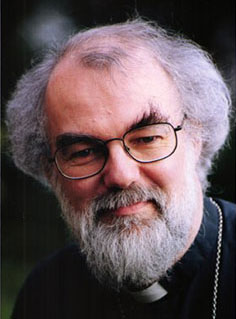
Happy Birthday, Rowan Williams!


He and I are both sixty today. (He's the one on the right.)


Comments are off for obvious reasons.

Friday, 11 June 2010

Divorced Bishops: another nail in the coffin?

One of the most depressing experiences I ever had in a Diocesan Synod was the morning on which ours debated the proposals to change the Church’s regulations on the remarriage of divorcees.
Until 2002, considering the many other ‘easings’ of the Church of England’s doctrinal adherences, its position on divorce and remarriage had remained remarkably consistent with a traditionalist understanding of Scripture.
Legally, any Anglican minister could conduct a marriage ceremony for anyone whom the law allowed to marry — which by this stage obviously included divorcees. However, the Church asked and expected clergy not to exercise this right, precisely in view of Jesus’ teaching on the subject and the need for the Church to be faithful to this teaching. Though it was often said that divorcees ‘could not get married in church’, the real distinction was that they ought not to be married ‘according to the rights and ceremonies of the Church of England’.
What came before the Chelmsford Diocesan Synod in the late 1990s was the request from General Synod to sound out opinion before phrasing any legislation.
Speaking from the floor, I offered the view that there was certainly a case for permitting remarriage after divorce, even in the light of biblical teaching. Though the interpretation of the relevant passages was open to some debate, arguably Jesus himself allowed that adultery broke the marriage bond, leaving the offended party free to remarry, and St Paul allowed that a Christian deserted by a non-Christian spouse was similarly free. On top of this, we might also add a third possibility, of someone who was divorced before becoming a Christian, who had no idea of the dominical or apostolic teaching and who therefore could not be held responsible for their situation in the same way as would a believer.
Any legislation, I argued, could reasonably adopt this more ‘open’ position. The one thing we could not allow was simply a free-for-all which contradicted, or took no account of, what the Bible had to say.
Unfortunately, that was almost exactly what happened. But what I found completely demoralising was the succession not just of speakers but of evangelical speakers, including clergy, who denied the possibility of or need for any such discipline. In the end, an amendment I moved was voted down, and one of the key causes was a prominent evangelical in the diocese who argued that many of their new church members were coming precisely through marriage preparation they were already running for divorcees.
I have to say it was only a personal word afterwards from the then-Bishop John Perry that prevented me simply resigning from the Synod. That was several years ago, but the unpleasant taste still remains.
The reason for mentioning this is that the House of Bishops has now apparently decided that it will allow divorcees to become bishops. I must admit I was not aware that they couldn’t — I had rather assumed that since they could already (with, I believe, permission) become clergy, there was therefore no bar to their consecration.
This news does, however, have echoes of the earlier debate.
The point is this: there are many who, like myself, believe that remarriage after divorce is possible, but only in circumstances that take into account the witness of Scripture. Some may find even this unacceptable, but it is a long way short of an ‘anything goes’ approach. Thus if the announcement apparently to be made next month takes account of this, there is no reason for an automatic rejection of the proposal.
The worry, however, is that there will be no mention of the Lord’s or the apostle’s teaching — just a bringing into line of the bishops with the rest of the population. And this, I believe, would be disastrous.
It is quite obvious, looking back over the last forty or fifty years, that there were those in the Church of England desperate to find a way round Jesus’ ‘hard teaching’ at this point. The fact that it took so long to make the change is a witness to precisely how clear that teaching is. Yet after decades of resistance, when it came the change represented a sudden collapse of opposition. Yet if we can follow our own line on something which is so clear, we can pretty much make it up as we go along on matters which are perhaps less clear. Indeed, I remember Desmond Tutu stating very baldly with reference to just this issue that there were things the Church believed Jesus simply got wrong, due to his culture and situation.
This is also why I have thought it doesn’t really matter for some people what the Bible has to say about homosexuality, since we have seen that the decision-making bodies of the Church are quite capable of simply ignoring it.
We must await what the Bishops have to say, but for some of us it is simply another nail in the coffin. I am glad to note, however, that Archbishop John Sentamu was apparently a voice against any change. I do not know why, but I can only assume he felt there was some reason for sticking with the tradition. Nevertheless, on a matter of such weight, surely it would have been right at least to have consulted the Church as a whole?
John Richardson
11 June 2010
Anonymous users wishing to paste in the comments box need first to select 'preview', then close the preview box. When posting your comments please give a full name and location. Comments without this information may be deleted.

Thursday, 10 June 2010

Should atheists have children?

Some time ago, I had what I thought was a great plot for a science-fiction novel, only for it to turn up in Terminator 3. Today, I am feeling equally miffed in that the Australian philosopher Peter Singer has pre-empted me on a blog post in which I was planning to ask, “Why should atheists have children?”
The lead to Singer’s article came from the Anglican Mainstream site, which points to a comment on Singer’s post, which can itself be found on the New York Times blog site. It is the last of these which you should really read.
Singer is a truly radical thinker, with (as I argued in my debate with Richard Norman on whether we can be good without God) a much better grasp of the philosophical implications of atheism than someone like Richard Dawkins. To some people he is known as an advocate of ‘animal rights’, but that is not least because he views human beings as another species of animal, and therefore is willing to extend the same moral principles as apply to humans to the rest of the animal kingdom.
At the forefront of Singer’s thinking is the question of suffering and its avoidance. In simplistic terms, he is a ‘utilitarian’, evaluating actions overall by their outcomes in terms of bringing about the best of situations for the most of sentient organisms.
In his blog article, therefore, he pushes this thinking to examine a question which I am surprised has not been given greater prominence before, namely, given the inevitably limited quality of all human life, would it not be better, now that we know there is nothing more than this life and have the ability to control our reproductive capacity, simply to make sure that this is the last generation of human beings?
He is prompted to ask this, however, by the publication of a work by a South African philosopher David Benatar — someone of whom I admit to never having heard, but whom Singer describes as “the author of a fine book with an arresting title: ‘Better Never to Have Been: The Harm of Coming into Existence.’”
In evaluating Benatar’s work, Singer notes that there is an asymmetry in our thinking when it comes to begetting children. We are troubled at the thought of brining into existence a child whose quality of life might be very low, but we do not use the idea that they might be happy as a converse argument that we should try for conception. (In fact, as Singer observes, the reasons why people decide to have children are generally much more to do with their own happiness and quality of life than anything which might benefit the child.)
Benatar, however, notes that all human life involves some suffering and (if we are honest) considerable disappointment. Thus, for example, as followers of this blog will have noticed, my wife’s elderly father is currently in hospital where his illness may prove terminal and where he is experiencing not just weakness, but indignity. Yet every child born is potentially like to suffer the same or worse, at least towards the end of their life. Singer notes, “To bring into existence someone who will suffer is, Benatar argues, to harm that person,” but, he continues, “to bring into existence someone who will have a good life is not to benefit him or her.”
Therefore, in Singer’s words,
Few of us would think it right to inflict severe suffering on an innocent child, even if that were the only way in which we could bring many other children into the world. Yet everyone will suffer to some extent, and if our species continues to reproduce, we can be sure that some future children will suffer severely. Hence continued reproduction will harm some children severely, and benefit none.
Singer therefore offers this thought experiment to test our response to Benatar’s argument:
So why don’t we make ourselves the last generation on earth? If we would all agree to have ourselves sterilized then no sacrifices would be required — we could party our way into extinction!
As Singer points out, this has certain advantages, not least that we could stop feeling guilty about what we are doing to the planet. And we would not be depriving anyone of anything, for that potential ‘future generation’ simply does not, and will not, exist. As Singer puts it, “Can non-existent people have a right to come into existence?”
However, Singer himself rejects Benatar’s conclusions, and his justification for this is worth reading in full:
I do think it would be wrong to choose the non-sentient universe [ie, one with no human beings]. In my judgment, for most people, life is worth living. Even if that is not yet the case, I am enough of an optimist to believe that, should humans survive for another century or two, we will learn from our past mistakes and bring about a world in which there is far less suffering than there is now.
The first point to note here is that Singer makes quite a sweeping claim: “In my judgement, for most people, life is worth living.” Yet earlier in his post he is careful to apply his standards of judgement to “most people in developed nations”.
The reason for this is obvious: in under-developed nations, life for millions, if not billions, is a constant struggle. And indeed, Singer shows he is aware of this in his next sentence, “Even if this is not the case ...” Yet Singer basis his objection to Benatar’s pessimism on his own mere optimism and faith: “I am enough of an optimist to believe ...”
Singer, it seems, finally falls foul of the problem which affects many atheists, that they just do not want to act like one. A world without human beings is, for Singer (if you’ll pardon the pun) inconceivable, even if the only justification for its continuation is the blind hope that “things can only get better”.
Yet even he can only hope for a world in which there is “far less suffering”, not one in which there is none at all. And if the avoidance of suffering is important then we come back to the questions with which he concludes:
Is life worth living? Are the interests of a future child a reason for bringing that child into existence? And is the continuance of our species justifiable in the face of our knowledge that it will certainly bring suffering to innocent future human beings?
For a thinking atheist, these must be a real challenge.
John Richardson
10 June 2010
Anonymous users wishing to paste in the comments box need first to select 'preview', then close the preview box. When posting your comments please give a full name and location. Comments without this information may be deleted.

Cancelled birthday party

Not exactly the usual topic of the blog, but I need to let everyone who was coming know that my birthday party on the 19th June has had to be cancelled because Alison's dad is critically ill - and I don't know exactly who thinks they're coming! If it was you and you get this, can you e-mail me?

Anonymous users wishing to paste in the comments box need first to select 'preview', then close the preview box. When posting your comments please give a full name and location. Comments without this information may be deleted.

Wednesday, 9 June 2010

What is 'the whole church'?

Yesterday I was at a meeting of the Church of England Evangelical Council which was addressed by, amongst others, two self-confessed evangelical bishops. Part of the purpose of the meeting was to seek better understanding over the rĂ´le of bishops and to increase confidence between the evangelical constituency and the bishops themselves. What follows, therefore, is written in the spirit of trying to clarify and elucidate, rather than to ‘knock’.
In addressing the meeting, one of the bishops took pains to say early on that it had to be understood that he was a bishop to “the whole church”. This phrase is, I notice, also being used with reference to selecting and training candidates for the ordained ministry — it is emphasised that they have to see themselves as, and be equipped to be, ministers to the ‘whole church’.
It has to be said, however, that the hearts of many evangelicals sink precisely at this point, and that is because the concept of the ‘whole church’ can be understood in two quite different ways.
The phrase can simply mean ‘the church as it is, without favouritism’. And in this sense, it is fairly unexceptionable. The evangelical tradition clearly does embrace the ‘whole’ Church of England, and a bishop cannot, therefore, simply focus on evangelicals, even if he is one himself.
However, there is second sense in which the phrase may be used, which shades into the first, but which actually entails quite a different, and far more problematic, set of assumptions. And this is when it means ‘the church as it is, without distinction’.
In the first case, the Church of England is understood inclusively, embracing people of different styles, practices and even understandings, who are recognized as both Anglicans and Christians, despite their differences. However, that is not necessarily the same thing as may be implied in the second case, which could refer to the Church of England indiscriminately, as embracing people whatever their styles, practices and understandings.
As I have said, the two meanings are not entirely distinct. Nevertheless, behind them lie two quite different core assumptions about the meanings not only of the word ‘whole’ but the word ‘church’.
What, then, should we mean by ‘church’? Today there seems to be a lot of support for the idea that the ‘church’ is simply ‘the community of the baptized’ and that, furthermore, it is to be identified by people gathering together at the Lord’s Table. This is often described in terms of being ‘inclusive’, but I would want to argue that it is better described as being ‘indiscriminate’ — and that in the dictionary sense of being ‘without careful judgement’.
It is here, however, that the Thirty-nine Articles come to our aid, for they in fact give us a definition of the ‘visible church’ — the church with which we actually have to deal, rather than any abstract or idealized ‘true’ church of ‘genuine’ believers. Article XIX defines the church as follows:
The visible Church of Christ is a congregation of faithful men, in the which the pure Word of God is preached and the sacraments be duly ministered according to Christ’s ordinance in all those things that of necessity are requisite to the same.
Notice, however, that although this deals with the ‘visible’, actual, church, it does not ignore the question of individual faith. On the contrary, the “visible Church” is “a congregation of faithful men”, or in Latin “coetus fidelium”.
Now it has rightly been observed (by Paul Avis amongst others) that coetus refers to something wider than the local, ‘parochial’, congregation. However, it would be quite wrong to limit its sense to the diocese, which Avis attempts to argue is the true ‘local church’. Rather, we should take it as meaning a ‘community’, in the biblical sense of the ‘congregation of Israel’ (cf Ex 16:10, Vulgate).
An equally suitable translation of the phrase would then be “a community of the faithful”. However, this also means that the visible Church is not simply a gathering of the baptized. If that were so, we could (theoretically) go round our parishes gathering together a selection of those who were baptized as infants and have never darkened the doorstep of the church since, and say, “See, here is the visible church.”
The clear implication of Article XIX, however, is that the church is visible where there is something to see — and this is brought out further by the references to “the pure Word of God” and to “the sacraments ... duly ministered according to Christ’s ordinance”. And this visibility is indeed manifested in the local (parochial) congregation, for that (rather than in diocesan or larger gatherings) is actually where people assemble and where the word is preached and where the sacraments are administered. But although no church (in either sense) is perfect, and many churches are quite imperfect, we may conclude that the church is increasingly visible to the extent that these conditions are met: that the sacraments are duly ministered, that the pure Word of God is preached and that we find a community of the faithful.
When a bishop refers to ministering to “the whole church”, then, this ought to take into account the faithfulness of the community, the quality of the preaching, and the manner of the administration of baptism and holy communion (as those sacraments “ordained of Christ our Lord in the Gospel”, Article XXV, whose ministering can therefore be “according to Christ’s ordinance”, Article XIX).
To the extent that faith, preaching and the proper ministration of the sacraments are missing, to that extent we can rightly say that there is no visible church — and perhaps no church at all — even if the building may be full, the choir outstanding and the clergy busy.
This is further underlined by Article XXVI, which notes that,
... in the visible Church the evil be ever mingled with the good, and sometime the evil have chief authority in the ministration of the word and sacraments ...
On the one hand, this recognizes precisely the point acknowledged above, that the ‘visible’ church is not the ‘perfect’ church, for that is both unattainable and unknowable in this world. However, it also affirms a point sometimes scarcely acknowledged when modern Anglicans consider the nature of the church, namely that the church is not just a mixture of styles and outlooks but of the good and the evil, which therefore calls for action.
Thus when a bishop speaks of ‘the whole church’, he must not only look for the visible signs of the church, but he must also, as an expression of his episcopal office, look to encourage the good and redress the evil, so that the church becomes progressively more visible.
None of this is to overlook or deny what Article XXVII says about baptism:
Baptism is not only a sign of profession and mark of difference whereby Christian men are discerned from other that be not christened, but is also a sign of regeneration or new birth, whereby, as by an instrument, they that receive baptism rightly are grafted into the Church ...
Baptism must be regarded as ‘instrumental’, in the sense of conferring what it speaks about of the promises and grace of God, otherwise it is merely an empty gesture. But baptism is ‘rightly’ received only by those who (if necessary, when they come of age), “renounce the devil and all his works, and constantly believe God's holy Word, and obediently keep his commandments”. In other words, baptism grafts into the ‘community of the faithful’ only those who receive by faith what baptism confers.
If it could be agreed between evangelical bishops and the evangelical constituency that ‘the whole church’ was a reference to a community where we could expect to see faithfulness in manner of life and in the preaching of God’s pure Word, then there would undoubtedly be greater confidence between the constituency and those from their number who are now on the episcopal bench.
John Richardson
9 June 2010
Anonymous users wishing to paste in the comments box need first to select 'preview', then close the preview box. When posting your comments please give a full name and location. Comments without this information may be deleted.

Tuesday, 8 June 2010

Canterbury's continuing chaos: does anyone know what is going on?

(Update: Ken Kearon is interviewed here, but it does not, I think, make the overall situation clearer.)

The fallout for the Anglican Communion following the consecration of Mary Glasspool is, for many of us, becoming more confusing by the day.
Prior to the issuing of the Archbishop of Canterbury’s Pentecost Letter, the situation was, if distressing, nevertheless seemingly straightforward for the man or woman on the local equivalent of the Clapham omnibus.
Following on from the consecration of Gene Robinson in 2003, the Communion was experiencing three ‘pressure points’, subsequently addressed in the Windsor Report. These were:
Officially sanctioned blessings of same-sex relationships.
Consecrations of bishops in active same-sex relationships.
Cross-border interventions by bishops in other dioceses or provinces.
The Windsor Report called for ‘moratoria’ in all three areas — a term which clearly meant to ‘cease and desist’.
However — and this is an important point — these three issues were not threatened actions, but actions which had already taken place. In the context, therefore, it would seem that the call for a ‘moratorium’ could only therefore have one of two possible practical meanings:
either A. that no further actions of this nature be undertaken.
or B. that such actions that had been taken be rescinded.
It is very difficult, however, to see how ‘B’ could have been intended since it would have meant not only going back on the cross-border interventions but unseating a bishop in The Episcopal Church. Given that Gene Robinson was clearly being allowed to stay in place, the practical intention of the call for moratoria would have been presumed by most people to be ‘A’, that no further actions — blessings, consecrations and interventions — would take place.
Furthermore, subsequent events in the Communion would seem to reinforce this interpretation. As late as 2009, the Primates of the Communion issued a pastoral letter titled ‘Deeper Communion: Gracious Restraint’ which contained the following:
There are continuing deep differences especially over the issues of the election of bishops in same-gender unions, Rites of Blessing for same-sex unions, and on crossborder interventions. The moratoria, requested by the Windsor Report and reaffirmed by the majority of bishops at the Lambeth Conference, were much discussed. If a way forward is to be found and mutual trust to be re-established, it is imperative that further aggravation and acts which cause offence, misunderstanding or hostility cease. (Emphasis added)
The important phrase for the omnibus passenger is “further aggravation”. The natural understanding of this would be that former aggravation, whilst regrettable, has to be accepted as a ‘fact of life’. What must be avoided is anything which might add to the offence.
And what would this be? Given that the working concept of a ‘moratorium’ in the present situation is clearly not a rescinding of past acts, it would most obviously mean — in the mind of the omnibus passenger — further, additional, extra, actions of the proscribed kind. Thus if there were further cross-border interventions, additional approvals of same-sex blessings or extra consecrations of bishops in same-sex relationships, these would be breaches of the moratorium as it was understood to be functioning in the Communion.
Indeed, the events leading up to the consecration of Mary Glasspool would seem to reinforce this ‘common sense’ understanding. The Archbishop of Canterbury expressed his misgivings as the day drew near. Others hoped that there would be a continued ‘gracious restraint’. Metaphorically, it was as if the near bank of the Rubicon had been crossed, but the invaders had only gone halfway across the bridge. The question was whether any of them would actually step across to the other side.
This, as I say, is how the situation appeared to most of us. Yes, we were in a ‘cease-fire’, not at peace. But, to coin Churchill’s phrase, our ‘jaw jaw’ was better than our ‘war war’. What has happened following the consecration of Mary Glasspool, however, is a descent into chaos.
The fact that the Archbishop of Canterbury chose this moment to issue his ‘Pentecost Letter’ would seem to suggest that the ‘common sense’ view was correct — that the moratorium had been broken by The Episcopal Church, and it alone. The content of the letter, however, only makes sense if it is understood that other bodies within the communion have also broken the moratorium.
Yet the Primates’ letter of 2009 indicated that the ‘cease fire’ positions of the offending bodies were accepted and that ‘gracious restraint’ was being exercised provided no one proceeded beyond their existing ‘stop lines’.
In other words, regarding what is meant by a moratorium, the Primates seem to have been operating with version A above, whilst the Archbishop of Canterbury seems to be applying version B, though he was apparently prompted by a version A understanding.
If this is confusing enough, further confusion is now being introduced by the involvement of Canon Kenneth Kearon who has written his own letter to the ‘offending’ bodies.
The Archbishop’s letter referred to a ‘proposal’ that the offenders be removed from bodies participating in ecumenical dialogue. Furthermore, he went on to add,
I shall be inviting the views of all members of the Primates’ Meeting on the handling of these matters with a view to the agenda of the next scheduled meeting in January 2011.
Many (including myself) had taken this to mean that it would therefore be the Primates who would consider the proposal and decide on any actions to follow. Canon Kearon, however, says,
I have ... written to the person from the Episcopal Church who is a member of the Inter Anglican Standing Commission on Unity Faith and Order (IASCUFO), withdrawing that person’s membership and inviting her to serve as a Consultant to that body.
So much for the Primates. Canon Kearon goes on to add,
I have written to the Primate of the Anglican Church of Canada to ask whether its General Synod or House of Bishops has formally adopted policies that breach the second moratorium in the Windsor Report, authorising public rites of same-sex blessing.
At the same time I have written to the Primate of the Southern Cone, whose interventions in other provinces are referred to in the Windsor Continuation Group Report asking him for clarification as to the current state of his interventions into other provinces.
Are we to presume that, depending on the answers he receives, Canon Kearon may also withdraw the membership of these bodies form IASCUFO? That would seem to run counter to what the Archbishop said in his letter:
I am aware that other bodies have responsibilities in questions concerned with faith and order, notably the Primates’ Meeting, the Anglican Consultative Council and the Standing Committee. The latter two are governed by constitutional provisions which cannot be overturned by any one person’s decision alone, and there will have to be further consultation as to how they are affected. (Emphasis added)
Whilst the reference is to bodies in addition to IASCUFO, we may note that Canon Kearon is a member of the secretariat to the ACC. Whose decision, we may then ask, was it to write as Canon Kearon has done? Was it made by Archbishop Williams? If so, then his ‘proposal’ was not a suggestion for discussion, but a personal decision. Was it made by Canon Kearon? If so, he would seem to be acting alone. Of course, it may have been a joint decision between the two of them — but since when did this become the way to handle such matters.
Meanwhile, however, it is clear from his letter that Canon Kearon is operating with understanding ‘A’ above, when it comes to the nature of the current moratoria. He writes,
It was hoped to have held the gracious restraint requested on many occasions by the Instruments of Communion until the Covenant had been considered in-depth by all of the provinces. [...] However, the recent Episcopal election in Los Angeles has created a situation where the Archbishop has been forced to act ... (Emphasis added)
That being the case, however, why has he written to the other Primates — unless it is to establish that they have taken no further actions to imperil their position.
It is indeed confusing. Who is running the shop? What do we mean by ‘moratorium’? Why have the actions of TEC threatened the status of other members of the Communion? And will the Windsor Process finally deliver a Covenant which saves us from all this?
Sorry, the last comment is not meant to be taken seriously.
John Richardson
8 June 2010
Anonymous users wishing to paste in the comments box need first to select 'preview', then close the preview box. When posting your comments please give a full name and location. Comments without this information may be deleted.

Monday, 7 June 2010

Premier Radio Debate: Homosexuality and the Church

Here.

In response to listener requests Justin Brierley hosts two shows dealing with Homosexuality and Christian faith.
 

This second show addresses whether the church is homophobic in its attitude towards gay people.  Would a gay person feel welcome at an evangelical church?  Should practising gays be allowed to become church members or receive communion?  Has the church focussed on the gay issue to the exclusion of all other sins?

Mike Dark of the organisation "Accepting Evangelicals" is a gay Christian in a same sex relationship.  He says he experienced rejection and homophobia in his church when he "came out" as gay, but has since found a church where same sex relationships are welcomed.

John Richardson (who blogs as the Ugley Vicar) is part of the conservative-evangelical Anglican group Reform.  He believes there is a line to be drawn when it comes to the church condoning same sex activity among its members.

Martin Hallett is the former director of The True Freedom Trust.  As a Christian of homosexual orientation he chooses to remain celibate, believing the Bible does not condone same sex activity.  But he says the church is often guilty of homophobia too.
 

The first show is here.
 
Anonymous users wishing to paste in the comments box need first to select 'preview', then close the preview box. When posting your comments please give a full name and location. Comments without this information may be deleted.