Update: The full ruling can be read here.
Apparently, according to the High Court, Christians who are not willing to commend homosexual acts ought not to be given other people's children to foster.
If this is what was said, and if it is a valid judgement, is it therefore right that Christians should nevertheless be allowed to keep their own natural children, if they similarly will not commend homosexual acts to them?
Please give a full name and location when posting. Comments without this information may be deleted.
Monday, 28 February 2011


Thursday, 24 February 2011
Tabernacle, Creation and Sabbath -- building a 'rest home' for the people of God?
Recently I’ve been busy working on a long-term project to do with the opening chapters of Genesis. I’m encouraged by the fact that Augustine of Hippo wrote two volumes on this before he gave up, so I was thinking now might be a good idea to run a couple of things past the reading public.
The latest stage had me looking at where else the six days of creation are referred to in the Bible, apart from Genesis 1. And as far as I can see there are only two occasions, in Exodus 20 and Exodus 31:
And that’s apparently it! The second occasion, however, had me particularly intrigued, because it comes at the end of five-and-a-half chapters of detailed instructions on how and why to build a Tabernacle (Exodus 25:1-31:11).
The ‘why’ is in 25:8, where God says to Moses,
And then the details run on, page after page until chapter 31 where we hear about Bezalel son of Uri, the son of Hur, of the tribe of Judah, who is going to be filled with God’s Spirit to supervise the construction of what has been detailed in the previous chapters.
Then we get, almost out of the blue, the second reference to the Sabbath above (vv 12-17). Now my question was, “Why does this reference to the Sabbath come here?” And the answer I am exploring is that there are allusions throughout the instructions for building the Tabernacle to the situation described in the Genesis accounts of creation and the garden in Eden.
Compare the following table I drew up:
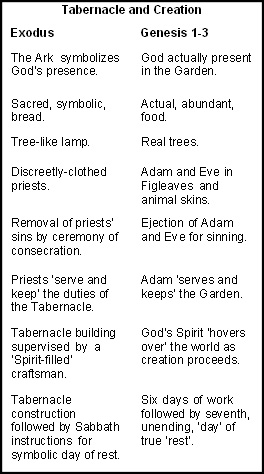
Should we perhaps see a parallel between the creation of the world in Genesis, which leads up to the seventh day of divine ‘rest’, and the construction of the Tabernacle in Exodus, which therefore (logically) leads up to the Sabbath day of symbolic ‘creation rest’ (when not only people but animals ceased from their labours)?
I notice, incidentally, that in Genesis 2, the seventh day is not actually referred to as a ‘Sabbath’. Indeed, the word doesn’t occur until Exodus 16:23 (which precedes the giving of the Ten Commandments). Does this underline the symbolic nature of the human Sabbath-day?
BTW, simply observing, “They’re different traditions” isn’t what I’m looking for by way of help! And for what it’s worth, I’ve already read John Walton and Gregory Beale who have some interesting things to say on these topics.
Please give a full name and location when posting. Comments without this information may be deleted.
The latest stage had me looking at where else the six days of creation are referred to in the Bible, apart from Genesis 1. And as far as I can see there are only two occasions, in Exodus 20 and Exodus 31:
Remember the Sabbath day by keeping it holy. [...] For in six days the Lord made the heavens and the earth, the sea, and all that is in them, but he rested on the seventh day. Therefore the Lord blessed the Sabbath day and made it holy. (Ex 20:8,11, NIV)
The Israelites are to observe the Sabbath ... for in six days the Lord made the heavens and the earth, and on the seventh day he abstained from work and rested. (Ex 31:16a,17b, NIV)
And that’s apparently it! The second occasion, however, had me particularly intrigued, because it comes at the end of five-and-a-half chapters of detailed instructions on how and why to build a Tabernacle (Exodus 25:1-31:11).
The ‘why’ is in 25:8, where God says to Moses,
Then have them [the Israelites] make a sanctuary for me, and I will dwell among them.
And then the details run on, page after page until chapter 31 where we hear about Bezalel son of Uri, the son of Hur, of the tribe of Judah, who is going to be filled with God’s Spirit to supervise the construction of what has been detailed in the previous chapters.
Then we get, almost out of the blue, the second reference to the Sabbath above (vv 12-17). Now my question was, “Why does this reference to the Sabbath come here?” And the answer I am exploring is that there are allusions throughout the instructions for building the Tabernacle to the situation described in the Genesis accounts of creation and the garden in Eden.
Compare the following table I drew up:
Should we perhaps see a parallel between the creation of the world in Genesis, which leads up to the seventh day of divine ‘rest’, and the construction of the Tabernacle in Exodus, which therefore (logically) leads up to the Sabbath day of symbolic ‘creation rest’ (when not only people but animals ceased from their labours)?
I notice, incidentally, that in Genesis 2, the seventh day is not actually referred to as a ‘Sabbath’. Indeed, the word doesn’t occur until Exodus 16:23 (which precedes the giving of the Ten Commandments). Does this underline the symbolic nature of the human Sabbath-day?
BTW, simply observing, “They’re different traditions” isn’t what I’m looking for by way of help! And for what it’s worth, I’ve already read John Walton and Gregory Beale who have some interesting things to say on these topics.
Please give a full name and location when posting. Comments without this information may be deleted.
Wednesday, 23 February 2011
Shields Up: Why Last Week’s Solar Storm Was a Dud
An interesting article here about last week's solar storm, why it was a bit of a 'fizzle', what has happened in the past and what may happen in the future. I particularly like the last line below:
Please give a full name and location when posting. Comments without this information may be deleted.
A strong flare would send ultraviolet and X-ray radiation to the sunlit side of the Earth, ionizing the upper atmosphere and potentially shutting down GPS satellites. Losing GPS would cause chaos in more than just car navigation systems, Bogdan said.
“GPS is involved in everything we do,” he said, including financial transactions. Prices fluctuate so quickly that traders need a time stamp accurate to a millionth of a second every time they buy or sell something. Every time you swipe your credit card at the gas station or buy a bag of oranges, Bogdan said, it goes through a GPS satellite.
Ten to 20 minutes after the flare, a burst of high-energy protons would enter the Earth’s magnetic field at the poles, causing processing errors in other satellites.
About half an hour later, the hot cloud of plasma that the sun spit out with the flare would bump into the Earth’s magnetic field. If it’s strong enough, the plasma’s magnetic field can induce currents in electric transmission lines, which could cause widespread blackouts. The most powerful solar flare in recorded history, the Carrington flare in September 1859, sent currents through telegraph wires and even set a few buildings on fire.
Please give a full name and location when posting. Comments without this information may be deleted.
Monday, 21 February 2011
Alcohol and social policy: "But when I'm with you I can't control myself"
Few people in our society are alcoholics, but many drink too much, as is evidenced in our town centres at weekends. And this is taking an undoubted toll on both drinkers and society. Indeed, according to reports in today’s news media, we face something of a crisis: “deaths from all alcohol-related causes — including cancers and road accidents — could claim the lives of 250,000 people in England and Wales over the coming two decades.”
And the costs involved include not only premature deaths and medical treatment of the sick, but clogged A& E units, damage to families, injuries to police and ambulance crews, lost working hours, and so on.
Clearly we have a problem. So what is to be done?
The answer being proposed by those raising the alarm is that the government should intervene. In particular, prices of alcohol should be raised. Thus the BBC reports a Department of Health spokeswoman saying,
The government has wasted no time in taking tough action to tackle problem drinking, including plans to stop supermarkets selling below-cost alcohol and working to introduce a tougher licensing regime.
And she adds that the government was taking “a bold new approach” to public health.
Frankly, in the area of politics nothing fills me with greater alarm than the news that any government is taking ‘bold new approaches’ on anything. The phrase ‘Fools rush in’ is usually the one that springs to mind.
However, it seems to me there is a deeper issue here, which is the assumption that this is basically a problem for the government to tackle through legislation.
Frankly, this is treating people like idiots, or like children.
Now of course people can behave like idiots, especially when they’ve been drinking. There is an old saying attributed to the Irish: “One drink, fine. Two drinks, plenty. Three drinks, nowhere near enough.” But it is perfectly possible for most people — alcoholics excepted — to identify the transition between that second and third drink and decide to stop.
In my student days I was rather fond of a tipple at weekends, which often left me with a hangover on Sunday mornings. One such morning, I remember walking across the student canteen with my lunch on my tray and feeling very queasy, when I thought to myself, “This is stupid. I don’t like feeling like this. I’m going to stop.” So I did. It wasn’t a great moral decision — just a realization that there were better things in life than spending a lot of money to feel ill the next day.
Here is Martin Luther making a similar point in a sermon:
God does not forbid you to drink, as do the Turks [Muslims]; he permits you to drink wine and beer: he does not make a law of it. But do not make a pig of yourself; remain a human being. If you are a human being, then keep your human self-control. (LW 51:296)
Luther’s appeal is not to the law (whether of God or Islam) but to human dignity. And to make such an appeal is itself to treat people in a dignified way.
The society that says, “There must be a law” at this (or similar) points, is already treating people as basically incapable — whether they are incapable through sin or through lack of self-control.
It says a lot for us, that in these early years of the twenty-first century, this is what some of our brightest and best assume must be the case when it comes to alcohol.
John Richardson
BTW, for those who may have missed it, the headline is a reference to The Troggs 1960s hit, "I can't control myself" (lyrics here, but watch out for pop-up ad). The wonderful thing about this particular single is that it refers to a time when self-control might have been thought necessary in a boy-girl relationship.
Please give a full name and location when posting. Comments without this information may be deleted.
BTW, for those who may have missed it, the headline is a reference to The Troggs 1960s hit, "I can't control myself" (lyrics here, but watch out for pop-up ad). The wonderful thing about this particular single is that it refers to a time when self-control might have been thought necessary in a boy-girl relationship.
Friday, 18 February 2011
It's the end of the Communion as we know it!
Two articles about what happens after Dublin, one taking a pretty sanguine approach, the other rather more pessimistic.
What makes it interesting is that they are both in agreement on the forthcoming shape of the Communion. Their only real disagreement is on the extent to which this matters to the Church.
Meanwhile, here in England I would venture to say that almost no members of Anglican churches have a clue about any of this.
The Anglican Communion is, to most of them, what Europe used to be to most Englishmen. When the Channel was foggy, it was Europe that was 'cut off'.
Anonymous users wishing to paste in the comments box need first to select 'preview', then close the preview box. When posting your comments please give a full name and location. Comments without this information may be deleted.
What makes it interesting is that they are both in agreement on the forthcoming shape of the Communion. Their only real disagreement is on the extent to which this matters to the Church.
Meanwhile, here in England I would venture to say that almost no members of Anglican churches have a clue about any of this.
The Anglican Communion is, to most of them, what Europe used to be to most Englishmen. When the Channel was foggy, it was Europe that was 'cut off'.
Anonymous users wishing to paste in the comments box need first to select 'preview', then close the preview box. When posting your comments please give a full name and location. Comments without this information may be deleted.
Saturday, 12 February 2011
Evangelical members of SSWSH
I would be interested to hear from any English Anglican Evangelicals (ie not Anglo-Catholics - no offence!) who have signed up to the Missionary Society of Saint Wilfrid and Saint Hilda.
I already have and know of two others, but there may well be more.
Please e-mail me via the link at the bottom of the left column.
Anonymous users wishing to paste in the comments box need first to select 'preview', then close the preview box. When posting your comments please give a full name and location. Comments without this information may be deleted.
I already have and know of two others, but there may well be more.
Please e-mail me via the link at the bottom of the left column.
Anonymous users wishing to paste in the comments box need first to select 'preview', then close the preview box. When posting your comments please give a full name and location. Comments without this information may be deleted.
A plea concerning women bishops
I have just e-mailed to as many Reform members and sympathizers as I can find in my address book a 'plea concerning women bishops'.
This is not something I want to post on this blog at the moment, but it is something I wish to receive a wide circulation in the Reform constituency.
If, therefore, this includes you, but you have not received a copy of the e-mail, I will send it to you if you contact me via the e-mail link at the bottom of the left column. You will need to include a full name, address and telephone number so I can check you against the Reform address list before sending a reply.
John Richardson
Anonymous users wishing to paste in the comments box need first to select 'preview', then close the preview box. When posting your comments please give a full name and location. Comments without this information may be deleted.
This is not something I want to post on this blog at the moment, but it is something I wish to receive a wide circulation in the Reform constituency.
If, therefore, this includes you, but you have not received a copy of the e-mail, I will send it to you if you contact me via the e-mail link at the bottom of the left column. You will need to include a full name, address and telephone number so I can check you against the Reform address list before sending a reply.
John Richardson
Anonymous users wishing to paste in the comments box need first to select 'preview', then close the preview box. When posting your comments please give a full name and location. Comments without this information may be deleted.
Thursday, 10 February 2011
Misleading Headlines, No. 12: Is it me, or is it a bit crowded in here?
You've got to wonder at this one:
Woman whose dog attacked police horses in court
Anonymous users wishing to paste in the comments box need first to select 'preview', then close the preview box. When posting your comments please give a full name and location. Comments without this information may be deleted.
Woman whose dog attacked police horses in court
Anonymous users wishing to paste in the comments box need first to select 'preview', then close the preview box. When posting your comments please give a full name and location. Comments without this information may be deleted.
The forgotten rôle of the 1993 Act of Synod
Recently I was at a meeting of evangelicals from the Diocese of Chelmsford which, at one stage, turned quite painful. The occasion was a discussion of the ‘Following Motion’ suggested by the Church of England Evangelical Council, to be put to deanery and diocesan synods considering the draft Bishops and Priests (Consecration and Ordination of Women) Measure being proposed by the General Synod.
The Following Motion urges the House of Bishops to bring forward amendments to the Measure in order to strengthen the provision of episcopal oversight for those “unable on theological grounds to accept the ministry of women bishops”.
Many evangelical Anglicans actually have no problem with this, but for the sake of those who do, the CEEC is sponsoring the motion specifically in the interests of evangelical unity.
Even so, in our own conversations it was clear that not everyone was willing to give their support, one of the stated reasons being that the 1993 Episcopal Ministry Act of Synod — the legislation that provided for the ‘flying bishops’ — had created “a mess”.
As the discussion became more detailed, I found myself checking the specifics of the Act, but also looking back at the original Priests (Ordination of Women) Measure itself. And what I found came as a surprise.
In what follows I may be mistaken both in terms of interpretation of the legislation and regarding what actually happened at the time and subsequently. Corrections will therefore be welcome. However, it seems to me that as the debate on women bishops nears its probable conclusion, there are things about the original provisions, and specifically the rôle of the Act of Synod, which have been forgotten.
First, there is the stark nature of the original Measure. This consists of three main parts plus a Schedule. The first simply allows the General Synod “to make provision by Canon for enabling a woman to be ordained to the office of priest”.
The third contains general material relating to interpretation.
But it is the second which is the most striking in the present context, given that it allowed an existing diocesan bishop to ‘opt out’ with his entire diocese:
(1) A bishop of a diocese in office at the relevant date [of the enabling Canon] may make any one or more of the following declarations—
(a) that a woman is not to be ordained within the diocese to the office of priest; or
(b) that a woman is not to be instituted or licensed to the office of incumbent or priest-in-charge of a benefice, or of team vicar for a benefice, within the diocese; or
(c) that a woman is not to be given a licence or permission to officiate as a priest within the diocese.
The only thing a woman could do in such a diocese, according to the Measure, was “officiate as a priest in a church or chapel for one period of not more than seven days in any period of three months without reference to the bishop or other Ordinary” (2.2.7).
And here is where the Act of Synod comes in. Bear in mind, however, that when the Measure went before Parliament, the Act itself had not been passed, or even presented to the General Synod. It was simply a plan in the House of Bishops to present the Act to the Synod the week after Parliament approved the Measure.
It is therefore important to read at length what the Archbishop of Canterbury, the Most Revd George Carey, had to say in the House of Lords on the 2nd November. Note especially the highlighted sections (the quotation is necessarily shortened for the sake of blog readers):
[...] Much attention has been focused on Clause 2 of the Measure which provides that a diocesan bishop, who is in office when the canon enabling women to be ordained priest is promulged, may make one or more of three declarations. By making all three of these declarations, a diocesan bishop could in effect exclude women priests from his diocese.
[However ...]
The potential significance of Clause 2 has substantially lessened as a result of the pastoral arrangements which the House of Bishops wishes to put in place once the canon is promulged.
[...]
The arrangements the House envisages are designed to ensure that appropriate pastoral episcopal care is provided for those in favour and those opposed to the legislation, without undermining the authority of the diocesan bishop. Our intention is to give continued space within the Church of England to those of differing views on this subject. The arrangements are embodied in an Act of Synod, which the General Synod will be invited to approve when it meets in London next week.
Thus the Act of Synod, whilst certainly having in mind the particular interests of those opposed to women priests, also made provision “for those in favour”, specifically as follows:
11 (1) ... where the bishop of the diocese has indicated that he is opposed to the ordination of women to the priesthood and, in case of a bishop in office at the relevant date, that he is unwilling to make a declaration under section 2 thereof, the ordination to the priesthood of women from the diocese and their licensing and institution shall be carried out by the archbishop concerned, either personally or through a bishop acting as his commissary; and the archbishop shall cause the archiepiscopal seal to be affixed to any documents that are needed for that purpose.
(2) The archbishop shall act under subsection (1) above either at the request of the diocesan bishop concerned or in pursuance of his metropolitical jurisdiction, but shall not so act unless he is satisfied that the diocesan bishop concerned has no objection.
(3) Subsection (1) above shall not apply where the bishop of a diocese has made arrangements for the ordination of women to the priesthood and their licensing and institution to be carried out by another bishop. (Episcopal Ministry Act of Synod 1993)
Hence, as the 2004 report of the House of Bishops’ Working Party on Women in the Episcopate observed, the Act of Synod not only took into account the view of those opposed to women priests but,
It made provision for the ordination, licensing and institution of women priests in dioceses where the diocesan bishop was opposed to the ordination of women priests. (Women Bishops in the Church of England? 2004, 4.2.47)
The Act of Synod, therefore, was not offered simply as a ‘messy’ response to the demands of traditionalists, but was an important part of a total package presented to embrace both sides. As Archbishop Carey said, for example, “the potential significance of Clause 2” of the original Measure was “substantially lessened” by the Act of Synod.
Moreover, it is clear from the Hansard record of the debate in the House of Lords that the assurances being given about the Act of Synod were fundamental to the successful passage of the Measure itself at the time. What Parliament considered was not simply the Measure in isolation, but a combined package of ‘Measure and Act’. The passionate closing speech of the Archbishop of York, one of the chief architects of the Act, bears this out:
People have said, “Well, it is possible to revert an Act of Synod”. Of course, it is possible to revert anything, even legislation. However, as I am sure that your Lordships realise, it is not very easy to reverse things in the Church of England; indeed, it is not easy to do anything in the Church of England, especially if one is trying to undo something. Any motion of that kind requires the approval of all three Houses. Therefore, once you have something, it is really quite hard to get rid of it. I believe that the House can, with confidence, vote for the Measures before us unamended. I feel that we will all come together and that the synod will, next week, see the point of enshrining this treasured diversity of the Church of England in the Act of Synod. (Emphasis added)
Yet the words of Lady Saltoun of Abernethy earlier in the same debate are also worth quoting at length:
I myself asked the most reverend Primate the Archbishop of Canterbury whether it was envisaged that the Act of Synod would operate in perpetuity or whether it would be in the nature of a temporary measure which would cease to operate at some future date. He replied that it was the intention that it should be permanent and that they were not thinking of rescinding it or anything like that. Then he added the caveat, “with the goodwill of the House of Bishops”. He went on to say that of course anything could happen in the future.
That is just the trouble. The fact is that the safeguards should have been incorporated in the Measure for the ordination of women. I feel that the General Synod underestimated the strength of the opposition to the Measure and thought that it would get it through with only such safeguards as are in Clause 2. I believe that it became clear to them that the majority of the members of the Ecclesiastical Committee, even many of them who supported the ordination of women, were concerned as to the efficacy of those safeguards and felt that they might be faced with an adverse vote in the committee. They produced the Manchester Declaration Mark II and the proposed Act of Synod very quickly. I am cynical enough to suspect that that was done out of necessity in order to get the Measure through Parliament and that, had the Ecclesiastical Committee in general not expressed such concern at the unfairness with which it was proposed to treat orthodox clergy and members of the Church, nothing would have been done at all.
Indeed, in the light of the Archbishop of York’s comments, her words now seem entirely prescient:
I want to concentrate on the safeguards for those who hold orthodox Anglican views, because I am concerned that those safeguards will be short lived. [...] They are to be enshrined only in an Act of Synod, which can be amended or rescinded at any time by a simple majority in the General Synod. Since we have no real guarantee that diocesan bishops who are opposed to the ordination of women will continue to be appointed, we wonder how long it will be before there is not one single bishop in the Church of England who does not support the ordination of women and who can therefore act as a provincial episcopal visitor to those who do not.
It is the history of what happened subsequent to 1993 that makes the need for ‘proper provision’ so urgent in the eyes of those who today remain opposed to the consecration of women as bishops.
The Act of Synod provided that “There will be no discrimination against candidates either for ordination or for appointment to senior office in the Church of England on the grounds of their views about the ordination of women to the priesthood.” And yet there has clearly been such discrimination.
The Archbishop of Canterbury suggested to a Peer that the Act of Synod would be ‘permanent’, and the Archbishop of York amusingly pointed out how hard it is to change things in the Church of England. And yet the Act of Synod has long been under threat and may soon be repealed.
Safeguards, provisions and assurances were offered and put in place in one generation, only for the current generation to propose removing them at a stroke.
And, of course, Parliament itself has changed its tune and may even be willing to force the Church of England to change accordingly.
No doubt, few if any of those opposing the request of ‘proper provision’ will think in terms of ‘betrayal’. And yet the words spoken just two decades ago do seem to tell a different story. The Act of Synod was vital then to giving supporters of women’s ordination what they wanted, when they wanted it, and that ought to be remembered in the current debate. But what ought also to be remembered, and acknowledged on both sides, is that the safeguards last time were not in the Measure. This time, they surely must be.
John Richardson
10 February 2011
Anonymous users wishing to paste in the comments box need first to select 'preview', then close the preview box. When posting your comments please give a full name and location. Comments without this information may be deleted.
10 February 2011
Tuesday, 8 February 2011
Baptismal Integrity
Completely by accident, whilst looking for something on a related topic, I came across this website titled Baptism Integrity, which claims to be (and probably is) “the only website dedicated to consideration of the issues of the theology and practice of baptism, christening and thanksgivings primarily in the Church of England.”
Back in the 1970s, when we were taught liturgy by the inestimable Colin Buchanan (not the Aussie singer, but the Bishop of Aston and, later, Woolwich), a ‘rigorist’ line on infant baptism was all the rage amongst alumni of St John’s Nottingham, many of whom (myself included) were extremely reluctant to baptize the children of non-churchgoers.
Indeed, for a brief while the whole issue was of interest to the Church of England. Since then, however, it has become of far less concern, and I suspect that, as in many other areas, private judgement reigns supreme amongst clergy as to what sort of policy they adopt.
More importantly — and I hope to catch up with the Synod debate on the subject — I suspect equally widespread confusion reigns as to what precisely we are doing in infant baptism, and not least regarding the relevance of the parents’ faith.
It took me quite a while to realize that if you follow the BCP then, technically, the faith of the parents is irrelevant. Thus, speaking to the godfathers and godmothers, the priest says (inter alia),
... this Infant must also faithfully, for his part, promise by you that are his sureties, (until he come of age to take it upon himself,) that he will renounce the devil and all his works, and constantly believe God's holy Word, and obediently keep his commandments.
I demand therefore,
Dost thou, in the name of this Child, renounce the devil and all his works, the vain pomp and glory of the world, with all covetous desires of the same, and the carnal desires of the flesh, so that thou wilt not follow nor be led by them?
A renunciation is indeed demanded, but from the child, not the parents and godparents!
Anyway, I’m sure there’s a debate to be had, but at this stage I just wanted to commend the website for people’s interest. There is a newsletter, and my old friend Taffy Davies, who used to do the covers of Grove Booklets, still seems to be drawing for them.
Go and have a read.
Anonymous users wishing to paste in the comments box need first to select 'preview', then close the preview box. When posting your comments please give a full name and location. Comments without this information may be deleted.
Saturday, 5 February 2011
Another 'must read'
George Conger is usually worth a read. This piece from the Church of England Newspaper, however, is outstanding - not least because it signifies an historical moment. As he identifies, the Primates' Council, which was once crucial for the doctrine and discipline of the Anglican Communion, has pretty much voted, in a very un-Turkey like fashion, for the ecclesiologial equivalent of Christmas: "Dr. Williams has now effectively gathered the authority once held by other instruments of the communion into his own hands, and into those of a London-based bureaucracy."
This is the new real politik of the Communion, and must equally be the signal for a new self-understanding of the Church of England:
Dublin primates meeting marks an ‘end to the communion as we know it’
Anonymous users wishing to paste in the comments box need first to select 'preview', then close the preview box. When posting your comments please give a full name and location. Comments without this information may be deleted.
This is the new real politik of the Communion, and must equally be the signal for a new self-understanding of the Church of England:
Dublin primates meeting marks an ‘end to the communion as we know it’
Anonymous users wishing to paste in the comments box need first to select 'preview', then close the preview box. When posting your comments please give a full name and location. Comments without this information may be deleted.
Wednesday, 2 February 2011
Now Read This
In the absence of anything from myself, I'd encourage people to read this article by Charles Raven:
Dublin and the Art of Dishonest Conversation
- a reflection on the recent Primates' Meeting in Dublin.
People are welcome to post comments here but PLEASE NOTE THE RULES BELOW:
When posting your comments please give a full name and location. Comments without this information may be deleted.
Dublin and the Art of Dishonest Conversation
- a reflection on the recent Primates' Meeting in Dublin.
People are welcome to post comments here but PLEASE NOTE THE RULES BELOW:
When posting your comments please give a full name and location. Comments without this information may be deleted.
Subscribe to:
Posts (Atom)