Showing posts with label Genesis. Show all posts

Tuesday, 5 March 2013

Toward a Biblical Theology of Marriage - New Testament (2)

1.         Godhead, Relationship and Marriage
The relationship between Christ and the Church is almost as significant as the relationships within the Trinity — diminished only by its being secondary, rather than primary, in defining the nature of God — for in that relationship we find the key to salvation itself.
It is because God can do something in relation to us — something which brings us into ‘union with Christ’ — that salvation is effected through Christ’s death on the cross and our union with him in his death.
Furthermore, we need to understand that this ‘marriage’ between the Creator-Redeemer God and his created-redeemed people is possible because of the nature of God himself. God is one who can be in a marital relationship.
An important insight into the nature of persons in the Trinity is provided by the notion of ‘perichoresis’. What this means is that each person in the Trinity is defined in terms of relationship with the others.
This is easy to grasp when we think of terms like ‘Father’ and ‘Son’. One can be an individual on one’s own, but one cannot be a father without a corresponding child or a ‘son’ without a parent.
So both the differences between and identities of the persons of the Trinity arise from their distinct relationship to the others.
But the marital relationship between Christ and the Church shows that God has a further relational potential — to relate to something outside himself, something which is not his own self, but whose qualities are such that God can relate to it almost, we might say, on equal terms. After all, what is a marriage if not a relationship between beings who are profoundly alike — or as Adam’s words in Genesis 2:23 put it, “bone of my bone and flesh of my flesh”?

2.         The Genesis of Marriage
In Ephesians 5, as we have noted, the Apostle applies the principles of Genesis 2:24 to Christ and the Church. But there are other ‘Christological’ elements of New Testament theology drawn from the narrative of Genesis 1-3.
Philippians 2:6-8, for example, is generally agreed to be contrasting the behaviour of Adam with that of Christ who, “being in very nature God, did not consider equality with God something to be grasped, but made himself nothing, taking the very nature of a servant” (cf Gen 3:5).
Or again, Christ’s lordship over all things may be seen as the ultimate fulfilment of the Genesis mandate. When Ephesians 1:22 speaks of all things being under Christ’s feet, it echoes the language of Psalm 8 (see v 6) which, with its reference to “all flocks and herds, and the beasts of the field, the birds of the air, and the fish of the sea (vv 7-8) is itself clearly echoing Genesis 1:28:
God blessed them and said to them, “Be fruitful and increase in number; fill the earth and subdue it. Rule over the fish of the sea and the birds of the air and over every living creature that moves on the ground.”
J V Fesko, Academic Dean and Professor of Systematic Theology and Historical Theology at Westminster Seminary, California, helpfully explores this Christological reading of Genesis in his Last Things First: Unlocking Genesis 1-3 with the Christ of Eschatology (Fearn Ross-shire Great Britain: Mentor, 2007).
In the present context, we would note that a Christological reading of Genesis 2 is particularly helpful in understanding the profound depths of the Christ-Church relationship.
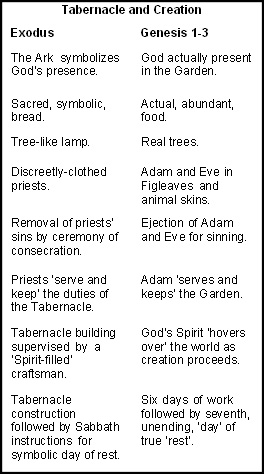
It may seem odd, for example, to think of Christ as in any sense resembling Adam at the point of the latter being put in the Garden to til and keep it. But it has been pointed out elsewhere that the language of Genesis 2 at this point parallels the priestly task of the Levites in relationship to the tabernacle — the dwelling-place of God — and that the tabernacle itself represents a miniature ‘Eden’ (see Gregory K Beale, ‘Eden, the Temple and the Church’s Mission in the New Creation’, JETS 48:1, 2005, 5–31).
And to think of Christ as the ‘temple keeper’ is by no means a demeaning of his person or his task.
Provided, therefore, we keep in mind that Adam is, in the words of Romans 5:15, “a pattern of the one to come” rather than the reality itself, it is perfectly legitimate to apply narrative details concerning him to the one of whom he is a pattern — in other words, to get clues as to how we should understand Christ by reading the account of Adam.
This being the case, however, we may also understand from the narrative of Genesis something about the relationship between Christ and the Church.
Thus, once again, it may seem odd, to say the least, to appear to suggest something lacking in Christ’s nature when we read in Genesis 2:18 that it was not good for the man to be alone and apply this to Christ.
Yet a ‘not good’ is not the same as a ‘bad’. To put it another way, ‘not having reached perfection’ is not the same as ‘having an imperfection. Specifically, when we read in Hebrews 2:10 that Christ was made perfect through suffering, this doesn’t mean there was something wrong with him.
Rather, we might think of a cake which, until it is baked is not finished, but is not ‘going wrong’ in the earlier stages of its preparation. And so Adam’s condition of ‘not good’ does not imply a fault in creation, but simply that the job is not yet finished.
Yet surely to suggest that Christ, like Adam, needed a ‘helper’ implies an inadequacy? In reply, we would simply point to what the New Testament itself declares, and observe that in relation to creation a ‘helper’ is precisely what Christ must and will have, and that this helper is his Church:
18 All this is from God, who reconciled us to himself through Christ and gave us the ministry of reconciliation: 19 that God was reconciling the world to himself in Christ, not counting men’s sins against them. And he has committed to us the message of reconciliation. (2 Cor 5:18-19)
Again,
28 Jesus said to them, “I tell you the truth, at the renewal of all things, when the Son of Man sits on his glorious throne, you who have followed me will also sit on twelve thrones, judging the twelve tribes of Israel. (Matthew 19:28, NIV)
Or again,
22 And God placed all things under his feet and appointed him to be head over everything for the church, 23 which is his body, the fullness of him who fills everything in every way. (Eph 1:22-23, NIV)
What, then, of Eve’s origin from Adam? Clearly the physical details do not apply, yet the Puritan writer William Gurnall was happy to draw a spiritual comparison (and I suspect from his Latin reference may have got this from an earlier source):
E latere Christi morientis exstitit ecclesia – the church is taken out of dying Jesus’ side, as Eve out of sleeping Adam’s. (The Christian in Complete Armour, Part 11, ‘Justifying Faith, as to its Nature)
Furthermore, the creation of Eve from Adam, if applied to the Church, is a reminder that human beings derive their nature from that of the one for whom they are made, for we are not just another creature, but the very ‘image of God’.
We should not forget that God has made us to be “conformed to the likeness of his Son” (Rom 8:29), and that therefore we will one day ourselves be images of the image (cf 1 Cor 15:49; 2 Cor 3:18; Col 3:9). Hence our claim above that we may legitimately apply spiritually to the Church in relation to Christ what Adam said physically of Eve:
This is now bone of my bone and flesh of my flesh ...

3.         The Gender of God
And this itself helps us answer the question as to in what sense God is ‘gendered’. In a world where godesses were commonplace, the Bible is unequivocal in applying the male gender to God.
Yet clearly a God without physical ‘parts’ is not ‘a man’, or even, in the biological sense, ‘male’.
Even so, he remains ‘he’, and as we have seen, in the marital relationship between God and Israel, he is the husband and Israel the bride.
Some might suggest this is a merely social convention, appropriate to a world in which patriarchy was the norm. But as we have seen above, the marital relationship between God and Israel, fulfilled in the relationship between Christ and the Church, is of too profound a significance to relegate to a matter of cultural convention.
Rather, we should see that the ‘masculinity’ of God, like the ‘Fatherhood’ of the Father or ‘Sonship’ of the Son, is relational — though in this case the relationship is not within the godhead, but rather between the godhead and that which is created to be the image of God.
The Creator-Redeemer God is ‘he’ in relation to that which he has created and redeemed — that which is his bride and in union with which he brings to pefection an image of his own self to which he will finally relate ‘face to face’ (cf Ex 33:11; Dt 5:4; 1 Cor 13:12).
This is the profound truth about marriage, and one which ought to govern our thinking.
Please give a full name and location when posting. Comments without this information may be deleted. Recommend:

Monday, 4 March 2013

Toward a Biblical Theology of Marriage - New Testament (1)


A Biblical Theology of Marriage — the New Covenant
1.         From Old Testament to New
The Old Testament contains two contrasting narratives regarding marriage. On the one hand, there is the decline we looked at in session 1 ‘from the garden to the harem’. The great king Solomon accumulates wives and concubines who, in the end, prove to be his downfall.
On the other hand, there is a clear understanding throughout the history of Israel that the nation stands in a ‘marital’ relationship with God — a relationship that is not abandoned by God, despite the unfaithfulness of the nation.
Hence in Jeremiah 3:14 we read,
14 “Return, faithless people,” declares the Lord, “for I am your husband. I will choose you — one from a town and two from a clan — and bring you to Zion.”
This, despite the circumstances of v 20:
“But like a woman unfaithful to her husband, so you have been unfaithful to me, O house of Israel,” declares the Lord.
Significantly, the New Covenant promise Jeremiah makes reference to this marital relationship:
31 “The time is coming,” declares the Lord, “when I will make a new covenant with the house of Israel and with the house of Judah. 32 It will not be like the covenant I made with their forefathers when I took them by the hand to lead them out of Egypt, because they broke my covenant, though I was a husband to them,” declares the Lord. (Jer 31:31-32)
This New Covenant is to be unbreakable (see vv 33-34), and so we may assume that the people of God will at last be his faithful bride. However, at the end of the Old Testament, that hope remains yet to be fulfilled. The arrival of Jesus signals its fulfilment.

2.         The Bridegroom Comes
Within Jesus’ own ministry, there are already hints at the ‘bridegroom’ role he plays. John’s gospel records that John the Baptist clearly understood the implications of the Christ’s coming in these terms:
28 You yourselves can testify that I said, ‘I am not the Christ but am sent ahead of him.’ 29 The bride belongs to the bridegroom. The friend who attends the bridegroom waits and listens for him, and is full of joy when he hears the bridegroom’s voice. That joy is mine, and it is now complete. 30 He must become greater; I must become less. (John 3:28-30)
The way that John describes the revelation of Christ’s glory at the wedding at Cana in Galilee John 2:1-11 is probably also meant to be seen as picking up this motif.
In the Synoptic gospels (Matthew, Mark and Luke) there are also references to Jesus as the bridegroom. In Matthew 9, challenged as to why his disciples do not fast, Jesus replies,
How can the guests of the bridegroom mourn while he is with them? The time will come when the bridegroom will be taken from them; then they will fast. (9:15; cf Mk 2:19-20; Lk 5:34-35)
In the parables, the return of the Messiah is also depicted in terms of the arrival of a bridegroom for a wedding feast (Matt 25:1-13), and the inauguration of the kingdom is compared to a wedding feast (Matt 22:1-14).

3.         Christ the Bridegroom
It is in the epistles (including Revelation), however, that we see the most developed understanding of Christ’s role as the bridegroom.
This ought not to worry us unduly. In the gospels, it is possible for Jesus to say to Peter, “Who do you say that I am?” (Mk 8:29), or for the disciples to ask in terror, “Who is this? Even the wind and the waves obey him.” (Mk 4:41). At this point, there are a number of possible answers (though only one correct one).
By the time we get to the epistles, however, the post resurrection-Christ and the Holy Spirit in the apostles, have already done their work, and those questions now receive definitive answers.
Thus, since Christ is the one in whom “the fullness of the deity lives in bodily form” (Col 2:9), all the Old Testament promises regarding God as the husband of Israel are transferred to Christ as the husband of the Church.
Indeed the apostle Paul sees his own apostolic role as that of a marriage-broker. In 2 Corinthians 11:2, he writes,
2 I am jealous for you with a godly jealousy. I promised you to one husband, to Christ, so that I might present you as a pure virgin to him.
And in the book of Revelation, the final ushering-in of the kingdom is depicted as the revealing of a bride for the Saviour-Messiah:
2 I saw the Holy City, the new Jerusalem, coming down out of heaven from God, prepared as a bride beautifully dressed for her husband. (Rev 21:2)
The last dialogue in the Bible is between the Spirit in the earthly Church and the longed-for Bridegroom:
17 The Spirit and the bride say, “Come!” [...] 20 He who testifies to these things says, “Yes, I am coming soon.” Amen. Come, Lord Jesus. (Rev 22:17,20)
In fact there may be a link theologically between the word spoken in v 17 above and the clearly primitive (because it is in Aramaic) invocation recorded in 1 Corinthians 16:22, where Paul writes, “Marana tha” (“Come, O Lord!”, NIV)
Arguably, this invocation (presumably quoted rather than coined by the apostle) is the same voice of “the Spirit and the bride” we read in Revelation — in other words the understanding of the Church as the ‘waiting bride’ was a very early tradition. Certainly we would not have to look far for the sources of such a tradition, for of course it is as old as the Old Testament itself.

4.         Marriage and Salvation
It would be fair to say, furthermore, that Paul’s ‘marital’ understanding of the relationship between Christ and the Church is central to his soteriology — his understanding of salvation.
In Romans 7, for example, the Christian community is likened to a woman whose husband has died, freeing her to marry another.
2 For example, by law a married woman is bound to her husband as long as he is alive, but if her husband dies, she is released from the law of marriage. 3 So then, if she marries another man while her husband is still alive, she is called an adulteress. But if her husband dies, she is released from that law and is not an adulteress, even though she marries another man. (Rom 7:2-3)
The illustration is complex, however, because the Church is itself depicted as dying:
4 So, my brothers, you also died to the law through the body of Christ, that you might belong to another, to him who was raised from the dead, in order that we might bear fruit to God. (Rom 7:4)
This may seem muddled, but the complication arises because Christ is both the husband who has died and the live husband. When he dies, he dies under the law — he is in the place of our first ‘husband’. But we also die with him (a fact expressed by our baptism ‘into his death’).
The same background thinking is present in Galatians :
19 ... through the law I died to the law so that I might live for God. 20 I have been crucified with Christ and I no longer live, but Christ lives in me. (Gal 2:19-20a)
13 Christ redeemed us from the curse of the law by becoming a curse for us, for it is written: “Cursed is everyone who is hung on a tree.” (Gal 3:13)
Our old ‘husband’, the law of sin and death, dies on the cross when Christ dies for us. What is often overlooked, however, is that not only does Christ die for us, but we die with him. There is an identity between the ‘sinful sinner’ (namely ourselves) and the ‘sinless sin-bearer’ who is Christ. And this identification depends on the marital relationship between the Redeemer and the redeemed.

5.         The Body of Christ
Anyone reading Paul will soon discover his liking for ‘body’ language in relation to the Church. In Romans 13 and 1 Corinthians 12 particularly, the church is compared to a body with many parts, so each believer is encouraged to see that they do not have to be a ‘Jack of All Trades’, but rather have particular (and limited) gifts which contribute to the life of the whole.
This is not just a convenient illustration, however. We might make the same point in other ways, for example by talking about an army with different units or a city with different trades.
The body language Paul uses stems from his understanding that the Church is specifically Christ’s body. And it is his body because of its marital union with him.
In 1 Corinthians 6, for example, he writes,
16 Do you not know that he who unites himself with a prostitute is one with her in body? For it is said, “The two will become one flesh.” 17 But he who unites himself with the Lord is one with him in spirit.
This idea is most fully developed, however, in Ephesians 5. Here, husbands and wives are urged to see themselves as living in a symbiotic relationship which reflects the relationship between Christ and the Church. Thus he writes,
28 ... husbands ought to love their wives as their own bodies. [...] 29 After all, no one ever hated his own body, but he feeds and cares for it, just as Christ does the church — 30 for we are members of his body. (Eph 5:28a,29-30)
And the rationale for this is drawn directly from the second chapter of Genesis, which Paul immediately quotes from to reinforce his argument:
31 “For this reason a man will leave his father and mother and be united to his wife, and the two will become one flesh.” 32 This is a profound mystery — but I am talking about Christ and the church. (Eph 5:31-32)
For Paul, this is another example of biblical typology, where something found in the Old Testament reaches its fulfilment in the events of the New. In Colossians 2, Paul applies this to festivals, new moons and the Sabbath:
17 These are a shadow of the things that were to come; the reality, however, is found in Christ. (Col 2:17)
Here in Ephesians, he sees the ‘one flesh union’ of married couples, beginning with Adam and Eve, as fulfilled in Christ and the Church. These two also become ‘one’, which is how Paul can go on to say so categorically that we died with Christ, we are raised with Christ and even that we are circumcised in him (Col 2:11).
The sixteenth century Reformer, Martin Luther, made great play of this in his understanding of salvation. Thus he wrote,
By this mystery, as the Apostle teaches, Christ and the soul become one flesh. And if they are one flesh and there is between them a true marriage — indeed the most perfect of all marriages, since human marriages are but poor examples of this one true marriage — it follows that everything they have they hold in common, the good as well as the evil. Accordingly the believing soul can boast of and glory in whatever Christ has as though it were its own, and whatever the soul has Christ claims as his own. Let us compare these and we shall see inestimable benefits. Christ is full of grace, life, and salvation. The soul is full of sins, death, and damnation. Now let faith come between them and sins, death, and damnation will be Christ’s, while grace, life, and salvation will be the soul’s; for if Christ is a bridegroom, he must take upon himself the things which are his bride’s and bestow upon her the things that are his. If he gives her his body and very self, how shall he not give her all that is his? And if he takes the body of the bride, how shall he not take all that is hers? (LW 31:35)
Luther, I think, captures well the implications and application of the Pauline position.

6.         The Genesis of Marriage
What we must understand from this, therefore, is that marriage is not simply a human ordinance or a social construct. Rather, as the Roman Catholic theologian Edward Schillebeeckx rightly says, it is a ‘saving mystery’. The Church of England reflects this understanding in its marriage service, where the Book of Common Prayer says,
... holy Matrimony ... is an honourable estate, instituted of God in the time of man’s innocency, signifying unto us the mystical union that is betwixt Christ and his Church ...
Human marriage takes its being from something far more significant than a social convention, a biological imperative or a legal construct.
Human marriage ultimately mirrors the relationship between the Creator-Redeemer God and his created-redeemed people, which is a saving relationship not just because of the love of God for his people, but because of the union of Christ with the Church.
The linguist and social theorist Noam Chomksy once coined the term ‘deep structures’ to talk about those aspects of language which lie beyond the mere use of ‘names for objects’ and ‘words for actions’ — aspects we codify as ‘grammar’, but which make up a kind of fundamental, inbuilt pattern that shapes all language.
In a similar way, we might say that theologically speaking, marriage is part of call the ‘deep structures’ of the universe — as foundational to reality as ‘love’, ‘goodness’ and ‘personhood’. For in that which is reflected in human marriage we find the key to salvation itself. It is because God can do something in relation to us — something which brings us into ‘union with Christ’ — that salvation is effected through Christ’s death on the cross and our union with him in his death.
Please give a full name and location when posting. Comments without this information may be deleted. Recommend:

Thursday, 28 February 2013

Towards a Christian Cosmology


As people who know me will be aware, I am a ‘dabbler’ in astronomy. One area that fascinates me in particular is cosmology — a few years ago I even managed to stagger my way through Brian Green’s The Fabric of the Cosmos: Space, Time and the Texture of Reality. (And for a bit of fun, click here to see Brian Green being ribbed by Sheldon and Amy on an episode of The Big Bang Theory — a show which is another of my favourite things.)
The subject matter of cosmology comes down to how the universe got to be here and why it is the way it is. Phenomena such as cosmic background radiation, or the red shift of most objects in the universe challenge cosmologists to put forward theories and models that fit what we observe about the physical world.
It is all great fun. The problem, however, is that in many cosmologies, and certainly in the prevailing ‘pop-cosmology’ written for folks like me, human beings wind up as an accidental by-product. Indeed in the worst cases, we almost seem to fit the apostle Paul’s description of himself and his companions as “the offscouring of all things” (1 Cor 4:13).
And this is somewhat ironic, when you consider that it is these same ‘persons’ who have the ability and inclination to seek an understanding of the universe that they then interpret as denying them any ‘universal’ significance.
There are, of course, some exceptions. Paul Davies, for one, appeals to the ‘anthropic principle’ as a possible basis for cosmology — in his case the view that the emergence of minds like ours retrospectively determined the physical constants that made their emergence inevitable. For the most part, however, modern cosmology uses its astonishing insights and suggestions to relegate us to the margins of the very reality it sets out to study.
This is one reason why I think it is important for Christians to develop their own cosmology, drawing not on physical data but on the data of revelation, particularly that found in Scripture. And whilst what we might call ‘natural cosmology’ addresses the existence universe at the level of its physical components, a ‘spiritual cosmology’ would address the ‘big picture’ which includes ourselves as persons and all that ‘personhood’ represents.
Indeed a Christian cosmology begins with a person — the person of Christ. Perhaps the most significant statement regarding whom in this regard is found in Colossians 1:16, where it says that “all things were created by him and for him” (NIV).
Speaking from this passage, I have often said that if you want to make a cup of tea for me, you need to start with my tastes in tea, not yours. Two sugars and plenty of milk is not going to evoke my happy face (such as it is).
Thus we need to look to the character of Jesus if we are to understand what sort of world would be made ‘for him’. And in this regard, I believe Scripture says something profoundly important (which I have explored in my booklet The Eternal Cross) to the effect that Christ’s character in relation to the world is always and essentially that of the ‘slain lamb’. Thus Peter writes,
For you know that it was not with perishable things such as silver or gold that you were redeemed from the empty way of life handed down to you from your forefathers, but with the precious blood of Christ, a lamb without blemish or defect. He was chosen before the creation of the world, but was revealed in these last times for your sake. (1 Pe 1:18-20, NIV, cf Eph 1:4; Rev 5:6)
That being the case, however, we ought not to be surprised that the world — our ‘cosmos’ — is one appropriate to a dying Saviour. In other words, sin, death, illness, disease, decay, etc are exactly what we ought to expect (just as they are, of course, exactly what we find).
Similarly, we ought to expect that we ourselves are of necessity creatures who need saving by a dying Saviour. As has often been said, it is not that God had a ‘plan A’ which then had to be turned into a ‘plan B’ when sin came along. However, this observation follows not just from the sovereignty of God but from the character of Christ.
I have often mused on the fact that according to Genesis 3:22, it would seem that the post-Fall human couple were more like God than they were pre-Fall. What the serpent promised (“you will be like God”, 3:5) has come true (“the man has now become like one of us”). Of course this is why we also need the one who will strike the serpent’s head at the cost of the serpent striking his heel (3:15). But given that Christ had already been ordained for this “before the creation of the world”, it raises in my mind the question as to whether the achievement of becoming “like one of us” could have been brought about any other way.
Implicit in this, therefore, is what I would term a ‘benign necessitarianism’. This, if I have understood him correctly, is essentially the view put forward by the Christian philosopher Norman Kretzmann. In answer to the question ‘Why would God create anything at all?’, his answer, essentially, is ‘Because he is like that.’
The term ‘necessitarianism’ refers, therefore, to the way in which creation is, to some extent, a ‘necessary’ action on God’s part. But it is ‘benign’ because, rather than being constrained by some external factors, God is impelled by his own nature.
And this brings us to a further feature of a Christian cosmology, which is to suggest that the nature of Christ entails the existence of the Church. Indeed arguably it is the Church of which it can most truly be said, ‘This was made for him.’ One of the reasons for taking this view is found in Kretzmann’s own arguments (drawing, amongst others, on Thomas Aquinas) that it is God’s love that drives the act of creation. The Church is thus supremely the object of the love of God shown to us in Christ Jesus.
I have argued elsewhere (though I drew some flak for doing so) that the account of the creation of the woman in Genesis 2 is itself an example of biblical ‘typology’ in this regard. Adam is ‘self-sufficient’ as regards his physical existing and his imaging of God in his personhood. There is no deficiency in him, yet it is ‘not good’ that there should be ‘only him’ (Gen 2:18, the proper sense of the Hebrew word translated ‘alone’ in most English versions). And the woman — taken from him and participating in his life rather than being a further derivation from the dust of the ground — is both the remedy to this ‘not good’ and a forerunner of the bridal Church in relation to her husband in Christ, an image in which the one imaged finds a separate self to love as his own self.
Furthermore we need to be aware that this ‘spousal relationship’ between the Creator-Redeemer God and his created-redeemed people goes to the very heart of the nature of our salvation (consider 1 Cor 6:16-17, for example) and again points back to factors relating to our ‘cosmology’.
All this is by way of very preliminary thoughts, but I sometimes worry that I won’t ever get round to developing these ideas more fully. I therefore offer them for your consideration and, perhaps, for your own further development.
Please give a full name and location when posting. Comments without this information may be deleted. Recommend:
Saturday, 5 January 2013

Rethinking Adam and Eve Today

Just back from a break in Yorkshire, here's a piece that was published in the Church of England Newspaper just before Christmas. They offer 'turns' to various evangelical organizations, and this particular time it was Reform's go.
********************
Rethinking Adam and Eve Today
One issue raised by the defeat of the Measure to introduce women bishops is the need for evangelicals to think more carefully about the Genesis account of Adam and Eve, and particularly the situation before and after the fall.
In a 1975 article (‘What is the Woman’s Desire?’, Westminster Theological Journal, 37:376-83), Susan T Foh explicitly rejected the suggestion that ‘before the fall, man and woman were equal and that neither ruled’ (378). Yet for many evangelicals today, that is precisely the view to which they adhere, with the accompanying belief that the gospel restores relationships between men and women, both in the home and the Church, to this pristine condition.
Over against this ‘equality without rule’ is then set ‘hierarchy’ with all its negative connotations. ‘There is no hierarchy between the sexes,’ we are told, ‘in Genesis 2.’
And of course literally that is true: there is no ‘priestly rule’ of one person over another. But is it fair to say that there was a simple interchangeability? Certainly the Apostle Paul does not seem to think so. Rather, he detects what we might call a ‘non-reversible asymmetry’: ‘For man did not come from woman, but woman from man; neither was man created for woman, but woman for man’ (1 Cor 11:8-9, NIV).
Identical twins would be both symmetrical and reversible. You could swap one for the other and it would make no difference. Adam and Eve, however, are ‘asymmetrical’ (he is a man, she is a woman) and their relationship one to the other is not ‘reversible’.
Careful thought, furthermore, suggests a number of consequences to this. For example, Adam is older than Eve and has already experienced things she has not. Hence we may presume that he would have shown her round the Garden, rather than the reverse, that he would have informed her of God’s mandate and command, to which she would have listened, and so on. Similarly, Adam named the animals on his own authority, whereas Eve would have used the names he had given.
More fundamentally, as the Apostle indicates, Eve’s very life derives from Adam’s. In the beginning, nephesh (living being) came from the substance of the ground. Adam is nephesh from aphar (dust), the animals are nephesh from adamah (ground). Eve, however, is uniquely nephesh from the nephesh of Adam. He is the source of her life, not the other way round. And as the Apostle observes, she is made ‘for’ him, not he for her. 
All these factors suggest (at very least) that Adam would have exercised an initial lead which Eve would have followed. And whilst a fallen creature might indeed use this as an excuse for domineering, would not Adam have loved Eve by showing her how she would become his ezer, or ‘strengthener’ (2:18)?
Non-reversible asymmetry therefore need not be pernicious. Indeed it is what we find in the Trinity, where each of the ‘asymmetrical’ persons has a ‘non-reversible’ relationship with the others.
But the Apostle also reminds us (Ephesians 5:31-32), that just as Genesis 3 contains the proto-gospel (3:15), so Genesis 2 contains a proto-ecclesiology (2:24), for Adam and Eve’s ‘non-reversible asymmetry’ reflects that of Christ and the Church. And this has two further implications.
The first is that the non-reversible asymmetry of husband and wife indeed has implications for relationships in the household of God (eg Eph 5:21,33 cf 1 Tim 3:2-5). The second (suggested by J V Fesko, Associate Professor of Systematic Theology at Westminster Seminary) is that we should adopt a ‘Christological’ reading of Genesis 1-3 as a whole. And that will be increasingly important in the coming debate about gender and sexuality.

************
UPDATE: "Genesis 3 contains the proto-gospel" should be followed with (3:15) NOT (3:16) as originally posted.
Please give a full name and location when posting. Comments without this information may be deleted. Recommend:

Saturday, 1 December 2012

God, Christ and Gender


One of the issues that has arisen in the ongoing debates about the consecration of women bishops is the representative nature of those we commonly call ‘priests’. Specifically, it is being asked what their gender has to do with their humanity and therefore their adequacy for the ‘priesthood’.
If one takes an ‘iconic’ view of priesthood, then this is clearly pertinent. If the priest somehow ‘embodies’ Christ in performing the functions of priesthood — particularly the celebration of the Lord’s Supper — then it might be worth asking whether a woman can do this in exactly the same way as a man.
The best negation of the argument that it makes no difference is perhaps that put forward by CS Lewis in his 1948 essay ‘Priestesses in the Church’. “Why,” Lewis asked, “should a woman not in this sense represent God?” He continued,
Certainly not because she is necessarily, or even probably, less holy or less charitable or stupider than a man. In that sense she may be as ‘God-like’ as a man; and a given women much more so than a given man.
Such assumptions are taken for granted today. But Lewis had a different objection. “The sense in which she cannot represent God,” he wrote, “will perhaps be plainer if we look at the thing the other way round.” The full force of his argument requires quoting at length:
Suppose the reformer stops saying that a good woman may be like God and begins saying that God is like a good woman. Suppose he says that we might just as well pray to “Our Mother which art in heaven” as to “Our Father”. Suppose he suggests that the Incarnation might just as well have taken a female as a male form, and the Second Person of the Trinity be as well called the Daughter as the Son. Suppose, finally, that the mystical marriage were reversed, that the Church were the Bridegroom and Christ the Bride. All this, as it seems to me, is involved in the claim that a woman can represent God as a priest does.
Now it is surely the case that if all these supposals were ever carried into effect we should be embarked on a different religion. Goddesses have, of course, been worshipped: many religions have had priestesses. But they are religions quite different in character from Christianity. Common sense, disregarding the discomfort, or even the horror, which the idea of turning all our theological language into the feminine gender arouses in most Christians, will ask “Why not? Since God is in fact not a biological being and has no sex, what can it matter whether we say He or She, Father or Mother, Son or Daughter?”
But Christians think that God Himself has taught us how to speak of Him. To say that it does not matter is to say either that all the masculine imagery is not inspired, is merely human in origin, or else that, though inspired, it is quite arbitrary and unessential. And this is surely intolerable: or, if tolerable, it is an argument not in favour of Christian priestesses but against Christianity. It is also surely based on a shallow view of imagery. Without drawing upon religion, we know from our poetical experience that image and apprehension cleave closer together than common sense is here prepared to admit; that a child who has been taught to pray to a Mother in Heaven would have a religious life radically different from that of a Christian child.
We should note that even in Lewis’s day, the argument that God has no biological gender was advanced to ‘deconstruct’ the language used about God. And we should note also that Lewis is well aware of the effects of such deconstruction. Far from the use of ‘Mother’ instead of ‘Father’ being the harmless exchange of one metaphor for another, it would (at least in his view) lead to a religious life, and therefore a religion, “radically different from that of a Christian”.
Hence for Lewis the iconic significance of the priest required that the priest be male rather than female, for with the Church, he says, “we are dealing with male and female not merely as facts of nature but as the live and awful shadows of realities utterly beyond our control and largely beyond our direct knowledge.”
But what if you do not share Lewis’s iconic view of the priesthood or his sacramentalism with regard to priestly function? What if, as I have suggested earlier, you would allow that anyone and everyone, including women, could celebrate the Lord’s Supper? Is there still room for saying that gender matters, either in relation to God or to Christ? And what implications, if any, does this have for our thinking about ministry?
Our thinking about gender in this particular context has not one but two starting points.
One is biology. And here gender is relatively straightforward, being essentially a component of the process of sexual reproduction. I say relatively because even here there are complications. Some species, for example, exhibit hermaphroditism, where a single organism can function as either the ‘male’ or ‘female’ partner.
Down at the cellular level, however, everything is clear. Whether one is talking about the vegetable or animal kingdoms, sexual reproduction involves the fusion of two gametes (cells with half the usual pair of chromosomes) to form a zygote (a cell with a full complement of chromosome pairs, one from each of the parent organisms).
All the rest, as they say is commentary. But the commentary is both considerable and variable and gives us little by way of ‘rules’ either of gender characteristics or behaviours. Male and female are not hard and fast concepts — not that they are not essentially clear cut within a given species, but that taken as a whole they do not justify us making statements of the form ‘all males look like’, or ‘all females act like’.
At this point, however, we must introduce the spiritual dimension, for as Lewis says above, in the Christian religion we believe that “God Himself has taught us how to speak of Him”. And he does this from very early on.
In Genesis 1:26 we read that God first deliberates about making human beings: “Let us make man in our image, after our likeness ...”
Some, most notably the feminist theologian Phyllis Trible, have suggested that this adam is androgynous — a sexually undifferentiated ‘earthling’. But this is unsustainable for numerous reasons. Here we may note simply that the text goes on to speak of adam in the plural: “and let them rule over the fish of the sea, etc.” What ever God plans to make, there will be more than one of them.
And so we read how this works out in the next verse, which forms a poetic triplet (single Hebrew words are indicated by square brackets):
[And created he] [God] [man]* [in his image]
[In the image] [of God] [he created] [him]
[Male] [and female] [he created] [them].
In the first part of the triplet, adam has the definite article. But we need not translate this as ‘the man’ since frequently elsewhere (eg Gen 7:21) ha-adam simply means ‘humankind’. Nevertheless, as the second stanza shows, adam in this sense can be spoken of as a collective singular. To use a term which is now regarded as archaic, we are one ‘mankind’, not ‘men and women’ — a point brought out by Genesis 5:1b-2:
When God created man, he made him in the likeness of God. He created them male and female and blessed them. And when they were created, he called them “man [adam].” (NIV)
And though it is common to regard Genesis 2 as being a separate ‘creation narrative’, actually it brings home rather neatly the point made in chapter 1: there is a singular ‘adam’ before there is a plurality of male and female.
This means, furthermore, that we must address at this point the question of a ‘Christological’ reading of the opening chapters of Genesis, for in the New Testament the first Adam is clearly seen as anticipatory of Christ, “a pattern of the one to come” (Rom 5:14), who is therefore a ‘second Adam’:
So it is written: “The first man Adam became a living being”; the last Adam, a life-giving spirit. (1 Cor 15:45)
And this is of enormous significance in terms of our salvation, for the argument runs that what is true of the first in a negative sense is true of the second positively. Thus,
... since death came through a man, the resurrection of the dead comes also through a man. For as in Adam all die, so in Christ all will be made alive. (1 Cor 15:21-22)
When it comes to Genesis 1:27, therefore, we must hold the second and third stanzas in tension. God created a singular ‘man’ in his image and he created a plural ‘male and female’ also in his image.
Once again, we must understand this Christologically. The first point — that one man on his own can image God — must be true in order for what the Bible later affirms about Christ to be true also:
For he is the image of the invisible God, the firstborn over all creation. (Col 1:15)
Christ’s imaging of God lacks nothing. Furthermore, it is necessary that he be the full image-bearer, for we ourselves derive our imaging of God from him:
And just as we have borne the likeness [eikon, image] of the earthly man, so shall we bear the likeness [eikon, image] of the man from heaven. (1 Cor 15:49)
But here we must be very careful and again we must be ready to read Genesis Christologically, for what do we mean by ‘Christ’?
In attempting to do theology, there is a danger of treating the person of Christ in isolation, as if Christ were an abstract concept or, more plausibly perhaps, understood comprehensively as a member of the Godhead. That, however, would not be true, for Christ as we know Christ — Christ as he is revealed to us — is not an abstraction, nor even just the Second Person of the Trinity. Rather, as 1 Peter puts it, he is the lamb “chosen before the foundation of the world” (1 Pet 1:20).
Indeed, he is the one whose character determines the world as we know it, since it was made not only “by him” but “for him” (Col 1:16). His very character is that of ‘Creator Redeemer’, and therefore though it does not require, it entails another.
And it is here that the third stanza of Genesis 1:27 comes into play: “Male and female (in the image of God) he created them”, for what we see played out in the history of creation and redemption is that God images his own image.
God is imaged in Christ, in whom dwells the fullness of God taking bodily form in his creation (Col 1:19). And as Christ is imaged in us, so God is imaged in that which he has created which is entirely distinct from himself.
Now something of this is surely what we see in Genesis 2. We are told in 2:18 that it is ‘not good’ for Adam to be alone — a word which means not ‘lonely’ but ‘the only one of his kind’ (cf Gen 44:20; Ex 18:14, etc). Similarly, however, in God’s plan for creation, it is clearly not his intention that Christ should be ‘alone’. On the contrary, through Christ God is “bringing many sons to glory” (Heb 2:10). Therefore,
Both the one who makes men holy and those who are made holy are of the same family. So Jesus is not ashamed to call them brothers. (Heb 2:11)
But there is only one eternal Son who is “ the radiance of God’s glory and the exact representation of his being, sustaining all things by his powerful word” (Heb 1:3). Therefore these ‘images of the image’ must be both ‘the same as’ and ‘quite different from’ the eternal Son, whose image they bear by derivation from him rather than by nature.
And this, I suggest, is the theological heart of the concept of gender.
Following a Christological reading of Genesis 2, we stand in relation to Christ as Eve stood in relation to Adam. He recognized her as ‘bone of my bone, flesh of my flesh’. In a real sense she was him — an image of the image-bearer. But in another sense, she was quite distinct from him — a being in her own right. And this is brought out in her name: she is an ishshah, not an ish — a woman, not a man (and later an Eve, not an Adam). But she is an ishshah precisely because “she was taken out of man” (Gen 2:23).
And all of this sets the stage for the comment in 2:24 which Paul will pick up and place at the centre of his understanding of the Church and of the nature of our salvation:
For this reason a man will leave his father and mother and be united to his wife, and they will become one flesh. (Gen 2:24, cf Eph 5:31)
This is why, in the great drama of marriage and sexuality husband is to wife as Christ is to Church, which is again as head is to body. Christ is not alone, for that would be ‘not good’ in relation to creation. Rather, it is ‘Christ and the Church’ which constitutes the ‘one new man’ (Eph 2:15) ruling over God’s creation.
The Psalmist expresses a sense of mystery in relation to Genesis 1:
what is man that you are mindful of him, the son of man that you care for him? You made him a little lower than the heavenly beings and crowned him with glory and honour. You made him ruler over the works of your hands; you put everything under his feet (Ps 8:4-7)
Ephesians sees it fulfilled in Christ and the Church:
And God placed all things under his feet and appointed him to be head over everything for the church, which is his body, the fullness of him who fills everything in every way. (Eph 1:22-23)
God is thus rightly and always in relation to us ‘he’. And in marriage the husband is always to the wife as Christ, and the wife is always to the husband as the Church.
What this means for the ministry is simply (!) that what we do in the congregation should follow what we see revealed in Christ. But that, of course, may be a challenge to all of us in many ways.
Please give a full name and location when posting. Comments without this information may be deleted. Recommend:

Sunday, 26 August 2012

From Genesis to Jesus: Eve in Christian perspective

The narrative of Genesis 2 leads to the creation of the woman, Eve, from the man, Adam, and up to this point is largely rooted in its immediate, local context.
Like the narrative of Genesis 1, however, there is a trajectory that leads into the far future. Public debate about the creation narrative tends to focus very much on the issue of the ‘six days’. Indeed ‘six-day creationist’ has become a particular kind of theological label (or insult, if you are differently inclined).
However, the rest of the Bible takes almost no interest whatsoever in these six days. Indeed, they are only ever mentioned twice in the rest of Scripture, and then to highlight what does concern the Bible, namely the seventh day on which is based the institution of the Sabbath.
In this regard, the text of Genesis 1:1-2:3 points beyond the local context to the future — from this climax of divine rest will flow the future ‘mini-rests’ of the weekly break from human labour. As Christians, however, we see an even more significant sign, pointing not to a day in the week but to Christ. As Colossians 2:16-17 puts it,
Therefore do not let anyone judge you by what you eat or drink, or with regard to a religious festival, a New Moon celebration or a Sabbath day. These are a shadow of the things that were to come; the reality, however, is found in Christ. (NIV)
As with the similar ‘shadows’ of Old Testament priesthood and sacrifice (Heb 8:5), and indeed the Law itself (Heb 10:1), Christ is the substance who provides the reality foreshadowed in the earlier ‘types’.
But as J V Fesko has identified in his Last Things First: Unlocking Genesis 1-3 with the Christ of Eschatology (Ross-shire: Mentor, 2007) this means that Christ is also the hermeneutical key not just to the types in general, but to Genesis in particular. When we are asking ‘what does this mean?’, we must also ask, ‘what meaning does Christ give to this?’
That approach may seem controversial. Indeed some would assert that it will lead us to misread Scripture. But it is actually fundamental to our faith. In the story of the Ethiopian eunuch in Acts 8, Philip asks him, “Do you understand what you are reading?”, and when the eunuch describes his difficulty in deciding to whom Isaiah is referring in speaking about one “led like a sheep to the slaughter”, we are told that, “Philip began with that very passage of Scripture and told him the good news about Jesus” (Acts 8:35).
Thus, whilst the interpretation of Isaiah may still be a matter of academic debate, it would be perverse for a Christian to do anything other than follow Philip’s example — certainly if confronted with the same question.
When it comes to Genesis 2, therefore, we need to be aware that the text also has a trajectory leading into the future and that its final destination is Christ.
The trajectory begins with 2:24. From the Garden, we suddenly move to every future marriage;
For this reason a man will leave his father and mother and be united to his wife, and they will become one flesh. (NIV)
But it does not stop there, for as the Christian reader will probably know, this verse is picked up by the Apostle Paul and applied, once again, to Christ:
... for we are members of his [Christ’s] body.“For this reason a man will leave his father and mother and be united to his wife, and the two will become one flesh.” This is a profound mystery—but I am talking about Christ and the church. (Eph 5:30-32, NIV)
This is not, however, an application that Paul produces out of nowhere, like a rabbit out of magician’s hat. On the contrary, the link has been implicit throughout the Old Testament, where God’s relationship with Israel is commonly depicted in marital terms. On the one hand, unfaithfulness to God is described as ‘fornication’, ‘prostitution’ or ‘adultery’:
Be careful not to make a treaty with those who live in the land; for when they prostitute themselves to their gods and sacrifice to them, they will invite you and you will eat their sacrifices. And when you choose some of their daughters as wives for your sons and those daughters prostitute themselves to their gods, they will lead your sons to do the same. (Ex 34:15-16)
On the other hand, Israel’s own relationship with God is typically described in marital terms:
For your Maker is your husband— the LORD Almighty is his name— the Holy One of Israel is your Redeemer; he is called the God of all the earth. (Is 54:5)
Indeed, the life of the prophet Hosea is a ‘worked example’ of the difficulties of this relationship (and a reminder that God’s plan for our lives may include marriage but not necessarily a happy one).
Perhaps the most remarkable depiction of God’s marriage to Israel, however, is found in the sixteenth chapter of Ezekiel, where the nation is depicted as a foundling baby girl whom the Lord first rescues and then, when she reaches sexual maturity, marries:
... you were thrown out into the open field, for on the day you were born you were despised. Then I passed by and saw you kicking about in your blood, and as you lay there in your blood I said to you, “Live!” I made you grow like a plant of the field. You grew up and developed and became the most beautiful of jewels. Your breasts were formed and your hair grew, you who were naked and bare. Later I passed by, and when I looked at you and saw that you were old enough for love, I spread the corner of my garment over you and covered your nakedness. I gave you my solemn oath and entered into a covenant with you, declares the Sovereign Lord, and you became mine. (Ezekiel 16:5-8, NIV)
By contrast with the negative denouncements of Israel, therefore, her redemption is depicted as the renewal of the marriage covenant:
“The Lord will call you back as if you were a wife deserted and distressed in spirit— a wife who married young, only to be rejected,” says your God. “For a brief moment I abandoned you, but with deep compassion I will bring you back. In a surge of anger I hid my face from you for a moment, but with everlasting kindness I will have compassion on you,” says the LORD your Redeemer. (Is 54:6-8)
In the New Testament, then, this marital imagery is simply picked up and applied to Christ, most dramatically, perhaps, with the wedding scene that comes at the end of Revelation. The end of all things is hailed as “the wedding of the Lamb” (19:7), and then in 21:2 we have this vision:
I saw the Holy City, the new Jerusalem, coming down out of heaven from God, prepared as a bride beautifully dressed for her husband. (NIV)
At the close of the book, therefore, we see the present-day church longing for this event:
“The Spirit and the bride say, ‘Come!’ And let him who hears say ‘Come!’”
To the alarm of some, this invocation is followed by an imprecation — a curse:
I warn everyone who hears the words of the prophecy of this book: If anyone adds anything to them, God will add to him the plagues described in this book. And if anyone takes words away from this book of prophecy, God will take away from him his share in the tree of life and in the holy city, which are described in this book. (22:18-19)
In a most bizarre piiece of editing, the latest lectionary of the Church of England actually omits the verses telling us not to omit verses! But this is then followed by another invocation:
He who testifies to these things says, “Yes, I am coming soon.” Amen. Come, Lord Jesus. (22:20, NIV)
The interesting point comes when we compare this with the words in 1 Cor 16:22. The NIV translates this as “O come, Lord!”, but the Greek text preserves the fact that this is actually an Aramaic phrase: Marana tha!
Being in Aramaic, the dialect Jesus and his disciples spoke, rather than in everyday Greek, we must assume that this phrase came into use in the church from the very earliest times. As with Revelation 22:18-20, however, the invocation is again preceded by an imprecation: “If anyone does not love the Lord — a curse be upon him!” (NIV). Given the parallel between the two texts, we may therefore wonder whether the invocation should be understood the same way in both cases, not just as calling on the Lord, but specifically (as in Revelation) as a longing for the arrival of Bridegroom on the part of his Bride, the church.
Certainly Paul viewed the church in this way. In 2 Corithians 11:2 he writes,
I am jealous for you with a godly jealousy. I promised you to one husband, to Christ, so that I might present you as a pure virgin to him. (NIV)
But for Paul this is much more than a metaphor. On the contrary, the effectiveness of Christ’s saving work depends on the parallel paul draws between Adam and Eve on the one hand and Christ and the church on the other, centered on the idea of ‘one-flesh union’ expressed in Genesis 2:24.
For Paul, the benefits of Christ to the believer come about through our union with him. Thus he writes in Romans 6:3-5,
Or don’t you know that all of us who were baptized into Christ Jesus were baptized into his death? We were therefore buried with him through baptism into death in order that, just as Christ was raised from the dead through the glory of the Father, we too may live a new life. If we have been united with him like this in his death, we will certainly also be united with him in his resurrection. (NIV)
And the benefit of this union is seen in other areas as well:
For in Christ all the fullness of the Deity lives in bodily form, and you have been given fullness in Christ, who is the head over every power and authority. In him you were also circumcised, in the putting off of the sinful nature, not with a circumcision done by the hands of men but with the circumcision done by Christ, having been buried with him in baptism and raised with him through your faith in the power of God, who raised him from the dead. (Col 2:9-12)
Circumcision is not merely discarded. Rather, it is fulfilled in Christ, so that we who are ‘in him’ are also circumcised with him!
And all this comes from the application of the physical language of Genesis 2:24 to the spiritual life of the believer. Thus paul writes in 1 Corinthians 6:16-17,
Do you not know that he who unites himself with a prostitute is one with her in body? For it is said, “The two will become one flesh.” But he who unites himself with the Lord is one with him in spirit.
For Paul, however, the significance of this extends even beyond our own personal salvation. Ephesians 1 presents a a review of God’s plans and purposes from before creation to our full redemption:
Praise be to the God and Father of our Lord Jesus Christ, who has blessed us in the heavenly realms with every spiritual blessing in Christ. For he chose us in him before the creation of the world to be holy and blameless in his sight. In love (1:3-4, NIV)
[...]
And you also were included in Christ when you heard the word of truth, the gospel of your salvation. Having believed, you were marked in him with a seal, the promised Holy Spirit, who is a deposit guaranteeing our inheritance until the redemption of those who are God’s possession —to the praise of his glory. (1:13-14, NIV)
As vv 20-21 indicate, the those plans and purposes are being worked out through Christ’s resurrection and heavenly ‘session’:
That power [working for us] is like the working of his mighty strength, which he exerted in Christ when he raised him from the dead and seated him at his right hand in the heavenly realms, far above all rule and authority, power and dominion, and every title that can be given, not only in the present age but also in the one to come. (1:19-21, NIV)
But though Christ’s rule is ultimately to be established over all things, he does not rule alone, as we read in the next two verses:
And God placed all things under his feet and appointed him to be head over everything for the church, which is his body, the fullness of him who fills everything in every way. (1:22-23, NIV)
There are those, however, including Ian Paul (Women and Authority: The Key Biblical Texts Cambridge: Grove Books, 2011), who deny that Christ’s ‘headship’ here is a matter of rule:
In Eph 1:22 and Col 2:10 he [Christ] is head ‘over all things’ in most English translations. But the Greek cannot mean this, since word [sic] translated ‘over’ is huper, which everywhere else in the NT is translated ‘more than’ or ‘beyond.’ To express rule or authority ‘over’ something, Greek uses another word epi (as in Luke 19:14 and 27 ‘we will not have this man rule over us’). (16)
There are, however, a number of problems with what Ian Paul says here. First, huper is simply not translated “everywhere else in the NT” by ‘more than’ or ‘beyond’. A key meaning of the word is ‘for’ as in ‘on behalf of’: “pray for [huper] those who persecute you” (Matt 5:44). Another is ‘for’ in the sense of ‘on the same side’: “whoever is not against you is for [huper] you” (Lk 9:50).
Moreover, the sense of huper cannot always be conveyed by the two alternatives Ian Paul gives. In Matthew 10:24, for example, the NIV’s “A student is not above [huper] his teacher, nor a servant above [huper] his master” is clearly preferable to saying the student is not ‘more than’ his teacher or the servant ‘beyond’ his master.
‘Above’ is clearly a legitimate translation of huper, particularly in spatial terms. Thus the LXX of Deuteronomy 23:23 refers to “the sky which is above [huper] your head”. It would seem perfectly legitimate, therefore, to translate Ephesians 1:22 as “head above everything”. But in any case, the meaning and implications of this phrase would still have to be derived from more than just the single preposition.
Ian Paul inadvertently illustrates this by his reference to Colossians 2:10, for in fact this does not contain the word huper, even though the NIV reads “Christ, who is the head over every power and authority”. The Greek simply uses the genitive: “Christ, who is the head of every power and authority”.
But the sense is not merely that Christ is the ‘origin’ or ‘source’ of powers and authorities — Ian Paul’s preferred options. In the preceding verse, the Apostle writes that “in Christ all the fullness of the Deity lives in bodily form” (2:9). And in v 15 he observes that the powers and authorities have been disarmed, made a public spectacle of and triumphed over. Christ’s ‘headship’ in this regard is surely one of being ‘over and above’ as both the one who embodies the fullness of deity and the one in whom the usurping powers of the universe have been put down.
Regarding Ephesians 1:22, both the language and the biblical background make it clear that ‘rule over’ is indeed in view. First we read that God placed all things “under” Christ’s feet. To pursue the physical metaphor, and speak of Christ as the head and the church as his body, thus naturally puts him ‘above’ all things. The theological perspective is the same as that found in Philipians 2:9-11:
Therefore God exalted him to the highest place and gave him the name that is above [huper] every name, that at the name of Jesus every knee should bow, in heaven and on earth and under the earth, and every tongue confess that Jesus Christ is Lord, to the glory of God the Father. (NIV)
Furthermore the background to the Apostle’s thought in Ephesians is reflected in Psalm 8, especially v 6:
You made him [ie ‘man’ and the ‘son of man’, v 5] ruler over the works of your hands; you put everything under his feet: all flocks and herds, and the beasts of the field, the birds of the air, and the fish of the sea, all that swim the paths of the seas. (Ps 8:6-8, NIV)
And this Psalm is itself picking up what we read in Genesis 1:28:
God ... said to them, “Be fruitful and increase in number; fill the earth and subdue it. Rule over the fish of the sea and the birds of the air and over every living creature that moves on the ground.” (NIV)
The language of ‘filling’ in the LXX of this passage is picked up in Ephesians 1:22, which now uses the same verb (plēroō) to describe Christ as “filling everything” (cf 4:10, “He [Christ] who descended is the very one who ascended higher than all the heavens, in order to fill the whole universe”).
Thus there is a parallel between Genesis 1:28 and Ephesians 1:22-23. In Genesis, mankind is to “fill the earth and subdue it”, ruling over the other creatures of the world. This is picked up in Psalm 8 as a hymn of wonder, but as the writer of Hebrews observes, although we do not see this in human reality we can see it applying to Christ:
Yet at present we do not see everything subject to him [man]. But we see Jesus, who was made a little lower than the angels, now crowned with glory and honour ... (Heb 2:8-9)
And the same thought is expressed in Ephesians. It is Christ, filling everything in every way, who fufils the mandate of Genesis 1 to “fill the earth”, and it is Christ, who reigns over all things, who fulfils the mandate to “rule over” the works of God in creation.
But as have said, he does this in combination with the church and he is able to do this because he does it in union with the church. Christ is the head, and all things are under his feet, but between the head and the soles of the feet is his body, the church.
Thus the argument of Ephesians 5, concerning husbands and wives, is not a mere haustafel — a set of household rules setting out an early (and possibly unenlightened) Christian ethic. Rather, it give human expression to the divine principle undergirding not just our salvation, but God’s entire purposes in creation. Christ rules, but not ‘Christ alone’. The plans of God depend on the union between Christ and the Church, and everything that he has done in Christ with regard to the creation is for the church, and finally will be through the church.
No wonder Paul writes as he does in Ephesians 3:20-21,
Now to him who is able to do immeasurably more than all we ask or imagine, according to his power that is at work within us, to him be glory in the church and in Christ Jesus throughout all generations, for ever and ever! Amen. (Eph 3:20-21, NIV)
Please give a full name and location when posting. Comments without this information may be deleted. Recommend:

Friday, 24 August 2012

The woman Eve, so good Adam named her twice

Recently I have been putting together some thoughts on the first three chapters of Genesis for a short course at our local churches.
One of the things we dealt with yesterday was the ‘naming’ of the woman in Genesis 2:23,
“This time it is bone of my bone and flesh of my flesh;
this then shall be called ‘woman’,
for ‘from “man”’ was she taken this time.”
First, let’s deal with the translation of this verse. The above is my own concoction from comparing the Hebrew text with a number of English translations. The term translated ‘now’ (“this is now”) by the NIV indicates elsewhere an occurrence in a sequence (Gen 18:32; 29:34,35, etc). The reference is back to the previous ‘attempts’ to find a suitable companion for the man, “But for Adam no suitable helper was found” (2:20b).
Most English translations then opt for ‘she’ in the second line: “she shall be called ‘woman’” (NIV, ESV, ASV etc). However, the Hebrew is a masculine singular. I must admit to puzzling over the fact that it is a masculine, not feminine, singular since the reference is ostensibly to a feminine object. If anyone can help me out, I’d be grateful.
There are, however, three occurences of ‘this’ in the three lines. It is the first word of the first two lines and the last word of the last line. Young’s Literal Translation takes it that the reference of the ‘calling’ is back to the action referred to in the first line: “This is the proper step! ... for this it is called ‘Woman’ ...”. And whilst the translation may be awkward, it seems to me to have some merit. Thus I wonder whether the verb should not be taken as referring to the first of these, hence my suggestion “this then”, which tries to encompass both the woman and the action.
Punctuation is, of course, additional to the Hebrew text, but the inverted commas are put in to highlight the special nature of the words ‘woman’ (Heb ishshah), and ‘man’ (Heb ish) — the woman being literally a ‘from-man’ being. For both words, this is their first occurrence in the text, and thus it may be suggested we have here two ‘namings’.
But there are some who would question whether we have any naming at all. One such is Ian Paul, in what has become quite a popular work in some evangelical circles. For Paul this is a particularly important issue, since it might have bearing on the egalitarian-complementarian debate:
... it might be argued that the adam’s earlier naming of the animals emphasizes his authority over them (2:19-20), and that when God brings the woman to him (at which point we can truly speak of man and woman) he also names her. However, there is an important distinction between the two events. (Paul, Ian. Women and Authority: The Key Biblical Texts. Cambridge: Grove Books, 2011, 7)
Thus he continues,
The man grants each animal a name, using a naming formula ‘its name shall be called ...’ and none of these is a suitable helper. But in 2:23, instead of granting the woman a name, he recognizes who she is as ‘woman,’ as one taken from ‘man’; the Hebrew phrase is quite different: ‘of this one it will be said “woman.”’
There are a number of comments which can be made in response, however, both to Paul’s detailed remarks and to the overall suggestion.
First, we may note, but must reject (as in fact Paul himself rejects it in the same work, see page 6), any flirtation with the idea that what God originally creates should be understood as an andorgynous being — an ‘adam’ of indeterminate gender, rather than a man. Phylis Trible is a particular advocate of this in her book God and the Rhetoric of Sexuality. The idea, however, finds no real support in the text. Not least, we may note the remark in 2:22: “and he (God) brought her to the man (Heb ha adam). There is no change in Adam’s being (beyond the loss of a rib).
Secondly, despite Paul’s assertion above, there is actually no use of a ‘naming formula’ anything like “its name shall be called ...” earlier in the text. Where the animals are named, 2:19 reads, “And he brought them to the man (ha adam) to see what he would call it, and everything which he, the man, called each living creature, that was its name.”
In fact, the earliest (and indeed strictly speaking the only) use of the precise formula, “his name shall be called” that I can find in the Old Testament is the rather Pythonesque Deuteronomy 25:10: “And his name shall be called in Israel, The house of him that hath his shoe loosed.” (ASV)
We do, however, have earlier instances of ‘calling’ something by a name:
“God called the light ‘day,’ and the darkness he called ‘night.’” (1:5, NIV)
“God called the expanse ‘sky.’” (1:8, NIV)
“God called the dry ground ‘land,’ and the gathered waters he called ‘seas.’” (1:10, NIV)
In each case, the verb ‘to call’ is in the ‘qal’, active (perfect or imperfect), case: “he called”.
By comparison, in 2:23 the verb is in the ‘niphal’ case, indicating a passive or reflexive voice: “it (or she) shall be called”.
As we have seen above, Paul argues that this is “quite different” from the namings that have gone before, having the sense of identifying, rather than imparting, the name. Rather than the traditional “she shall be called” of most English versions, the meaning is, as he puts it, “‘of this one it will be said “woman.”’” Adam is not ‘naming’ the woman, but recognizing what she would be known as.
A comparison with other uses of the verb in this form shows that there could, in other circumstances, be some support for this conclusion. Thus we find the following:
“No longer will you be called Abram ...” (Gen 17:5, NIV)
“... you will no longer be called Jacob ...” (Gen 35:10, NIV)
“... the prophet of today used to be called a seer.” (1 Sam 9:9, NIV)
The niphal ‘shall be called’ is clearly not the same as the qal ‘he called’. Yet it is overstating things to deny that the former can in any sense be used with reference to naming. Consider Isaiah 1:26:
“I will restore your judges as in days of old, your counsellors as at the beginning. Afterward you will be called the City of Righteousness, the Faithful City.” (NIV)
Or again Isaiah 62:4:
“No longer will they call you Deserted, or name your land Desolate. But you will be called Hephzibah, and your land Beulah; for the LORD will take delight in you, and your land will be married. (62:4, NIV)
In these instances at least, the qal form of qārā comprises what might be called a ‘pronunciation formula’: “You will be known as ...” And it is hard to deny, certainly in the case of what God says, that such pronunciations are authoritative.
Moreover, when we come back to Adam in Genesis 2, God delegates the task of naming to the man: “He brought them to the man to see what he would name them ...” (2:19). This is particularly significant when we recall that all the earlier instances of naming were acts of God himself.
The pronouncement of Adam in 2:23, therefore, could be seen as no less ‘authoritative’ than those pronouncements of God we have observed in Isaiah: “This then shall be called woman” is comparable to “You will be called the City of Righteousness” or “You will be called Hephzibah”.
We might also add that since Adam is the only person around at this point in time, the obvious implication is that this 'being known as' begins with him. He is not picking up on what others are saying! In effect, therefore, his, "This then shall be called ...," is the same as, "I will call ...". (We might also add, by way of completeness, and contra Paul's suggestion above, the text does not tell us what he said regarding the animals. Does this not mean that, for all we know, he could have said of each animal, "This shall be called ..."?)
In any case, there are two other features of the narrative that need to be taken into account. The first is the clear parallel between 2:19 and 2:22. In 2:19 we read that God formed (Heb yātsar) the animals from the ground and brought (Heb bō’) them to the man, followed by a naming. In 2:22, God builds (Heb bānāh) the woman and similarly brings (Heb bō’) her to the man. Our natural expectation is that a naming will again follow — this is, after all, the climax of the hunt for the ‘suitable helper’ that began in 2:18.
To deny that 2:23 is a naming would not only go against the obvious flow of the narrative, but would indeed leave an unresolved tension.
Furthermore, we have noted the occurrence of previous, undisputed namings, in chapters 1 and 2. In chapter 1 God names five things in the natural world. In chapter 2, the act of naming is handed on to the man. The giving of names to the animals is thus a sixth naming act. Taking this line, the pronouncement regarding the woman in 2:23 is the seventh — and therefore the ‘perfecting’ or ‘completing’ — act of naming. At this point the tension introduced by the ‘not good’ pronouncement of 2:18 (in contrast to the seven ‘goods’ of chapter 1) is finally resolved.
For those who are still troubled by the fact that this is a naming at all, we would repeat our observation that it is, strictly speaking, a ‘double’ act — both ‘woman’ and ‘man’ are used here for the first time. However, we regard it as indisputably, and indeed in the flow of the narrative importantly, a naming.
That brings us to the second naming of the woman, in Genesis 3:20: “And he called, Adam, the name of his wife ‘Eve’ ...” Many, including Ian Paul himself, interpret this negatively. Thus regarding God’s words to the woman in Genesis 3:16 (“Your desire will be for your husband, and he will rule over you.”, NIV) he writes,
It is immediately apparent that this is no longer the harmonious equality of Genesis 1-2, and indeed the man immediately expresses his rule by naming the woman Eve, this time using a phrase similar to the naming formula used for the animals. (Ibid, 8 — note once again the reference to a 'naming formula' and see the comments above)
For Paul as for others, this is an act of, in his words, ‘domination’. In our view, however, this is a serious misreading of the text.
To begin with, contra what Paul writes above, the words of 3:20 obviously do not follow “immediately” on the words of 3:16. What intervenes after 3:16 is significant to our reading of 3:20, in particular the words at the end of 3:19: “for dust you are and to dust you will return.”
It is these words, not the words of 3:16, which should control our reading of the text of 3:20. (In any case 3:16 is patent of a different interpretation from the one assumed by Paul — see Susan Foh, ‘What is the Woman’s Desire’, Westminster Theological Journal 37 (1974/75) 376-83. Paul lists this in his references, but seems to take no account of her conclusions.)
The text has brought us to the final pronouncement of the ‘curse’ God warned would follow on disobedience in 2:17: “when you eat of it, you will surely die” (NIV). It is then that Adam names his wife ‘Eve’, “because she would become the mother of all the living” (3:20b, NIV).
This is surely not an act of domination but a prophetic expression of hope! I have often commented, when teaching on this passage, that there are any number of names a man might have been tempted to call a woman in such circumstances. Indeed, history is repleat with readings of the text that would suggest some ripe examples.
Adam had earlier blamed Eve and God between them for his own sin and downfall: “The woman you put here with me — she gave me some fruit from the tree ...” (3:12). Now he has been told that he (and by implication all his descendants) will die. Yet immediately (to use Paul’s phrase) he calls the woman chavāh, ‘Eve’, for she will become the ‘mother of all the chay (living)’.
Rather than being a ‘domineering’ act in keeping with a certain (though in my view false) interpretation of 3:16, this is not only an extraordinary insight but an act of both repentance (necessary to the change of heart towards the woman) and grace (since she has not actually done anything to deserve this). Adam recognizes, and in giving the name openly acknowledges, that the solution to the problem of death lies not with him but, ultimately, with the woman. What God has said to the serpent will indeed be true:
And I will put enmity between you and the woman, and between your offspring and hers; he will crush your head, and you will strike his heel. (Gen 3:15, NIV)
This is rightly called the protoevangelium — the ‘first gospel’ — and it is expressed in Eve’s name. What Adam sees is the good that will come via her, something so good he names her twice.
John Richardson
24 August 2012

PS: for those who might not get it, the title reference is to New York, N.Y, the city that, as the song has it, is 'so good, they named it twice'.
Please give a full name and location when posting. Comments without this information may be deleted. Recommend:

Thursday, 24 February 2011

Tabernacle, Creation and Sabbath -- building a 'rest home' for the people of God?

Recently I’ve been busy working on a long-term project to do with the opening chapters of Genesis. I’m encouraged by the fact that Augustine of Hippo wrote two volumes on this before he gave up, so I was thinking now might be a good idea to run a couple of things past the reading public.

The latest stage had me looking at where else the six days of creation are referred to in the Bible, apart from Genesis 1. And as far as I can see there are only two occasions, in Exodus 20 and Exodus 31:

Remember the Sabbath day by keeping it holy. [...] For in six days the Lord made the heavens and the earth, the sea, and all that is in them, but he rested on the seventh day. Therefore the Lord blessed the Sabbath day and made it holy. (Ex 20:8,11, NIV)

The Israelites are to observe the Sabbath ... for in six days the Lord made the heavens and the earth, and on the seventh day he abstained from work and rested. (Ex 31:16a,17b, NIV)

And that’s apparently it! The second occasion, however, had me particularly intrigued, because it comes at the end of five-and-a-half chapters of detailed instructions on how and why to build a Tabernacle (Exodus 25:1-31:11).

The ‘why’ is in 25:8, where God says to Moses,

Then have them [the Israelites] make a sanctuary for me, and I will dwell among them.

And then the details run on, page after page until chapter 31 where we hear about Bezalel son of Uri, the son of Hur, of the tribe of Judah, who is going to be filled with God’s Spirit to supervise the construction of what has been detailed in the previous chapters.

Then we get, almost out of the blue, the second reference to the Sabbath above (vv 12-17). Now my question was, “Why does this reference to the Sabbath come here?” And the answer I am exploring is that there are allusions throughout the instructions for building the Tabernacle to the situation described in the Genesis accounts of creation and the garden in Eden.

Compare the following table I drew up:


Should we perhaps see a parallel between the creation of the world in Genesis, which leads up to the seventh day of divine ‘rest’, and the construction of the Tabernacle in Exodus, which therefore (logically) leads up to the Sabbath day of symbolic ‘creation rest’ (when not only people but animals ceased from their labours)?

I notice, incidentally, that in Genesis 2, the seventh day is not actually referred to as a ‘Sabbath’. Indeed, the word doesn’t occur until Exodus 16:23 (which precedes the giving of the Ten Commandments). Does this underline the symbolic nature of the human Sabbath-day?

BTW, simply observing, “They’re different traditions” isn’t what I’m looking for by way of help! And for what it’s worth, I’ve already read John Walton and Gregory Beale who have some interesting things to say on these topics.


Please give a full name and location when posting. Comments without this information may be deleted.